Chiropractic care can play a meaningful role in managing scoliosis – but being honest about what it can and cannot do is just as important as explaining the benefits. At Axiom Chiropractic in Southpark, we work with scoliosis patients across a wide range of curve severities, and the consistent goal is the same: reduce the functional impact of the curve, slow progression where possible, and improve nervous system function within the structural reality of each patient’s spine. We don’t promise to straighten a scoliotic spine. We do help patients live and function better with the spine they have.
What Scoliosis Actually Is
Scoliosis is defined as an abnormal lateral curvature of the spine, typically measured by the Cobb angle on full-spine X-rays. A Cobb angle of 10 degrees or more qualifies as scoliosis. Curves below 20 degrees are generally considered mild. Curves between 20 and 40 degrees are moderate. Curves above 40 to 50 degrees are severe and are the range where surgical intervention is most commonly discussed.
The most common type – idiopathic scoliosis – accounts for roughly 80% of cases and has no identified single cause. It typically develops during the adolescent growth spurt and is more common in girls. Degenerative scoliosis develops in adults as asymmetric disc and joint degeneration creates lateral curvature over time. There are also less common forms caused by specific neurological or muscular conditions.
Scoliosis is not just a lateral bend. In most cases it involves vertebral rotation as well – the vertebrae twist around the vertical axis as they curve sideways, which creates the rib prominence visible in more significant curves and contributes to the asymmetric muscle tension that makes scoliosis physically uncomfortable.
What Chiropractic Can and Cannot Do for Scoliosis
Let’s be direct here, because patients deserve an honest answer before investing in a care plan.
What chiropractic cannot do: Permanently straighten a scoliotic curve. The structural shape of a scoliotic spine is not correctable through adjustments alone, particularly in adults whose spines have fully matured and whose curves have established compensatory patterns over years or decades. Claims that chiropractic will eliminate your curve should be treated with skepticism.
What chiropractic can do: Significantly improve the functional picture around a scoliotic spine. This includes reducing the pain and muscle tension associated with the abnormal loading patterns a curve creates, improving mobility in spinal segments that have become restricted by the curve, reducing nerve irritation at levels where the curved spine is compressing nerve roots, and in adolescent patients with still-developing spines, potentially slowing curve progression by reducing the mechanical drivers of asymmetric spinal loading.
For many scoliosis patients – particularly adults managing the chronic pain, fatigue, and restricted movement that come with established curves – the functional improvements from consistent chiropractic care are genuinely significant, even when the curve itself doesn’t measurably change on X-ray.
How Gonstead Assessment Applies to Scoliosis
The Gonstead method’s emphasis on full-spine imaging and objective measurement makes it particularly appropriate for scoliosis management. Most chiropractic techniques that use only localized assessment or sectional X-rays are working with an incomplete picture in scoliosis patients – because the curve affects the entire spine, not just the region that’s most symptomatic.
At Axiom, full-spine, weight-bearing X-rays taken in the Gonstead protocol show the complete picture of the scoliotic curve – the primary curve, any secondary compensatory curves, the degree of vertebral rotation, the Cobb angle measurement, and how the overall structure is loaded under gravity. This is the baseline from which realistic goals and a realistic care plan are set.
Instrumentation scanning with the Nervoscope identifies where nerve irritation is greatest along the curve – which is often not at the apex of the curve but at the transitional zones above and below it where mechanical stress concentrates. These are frequently the levels that drive a patient’s pain and neurological symptoms, and they’re the levels we prioritize in the adjustment protocol.
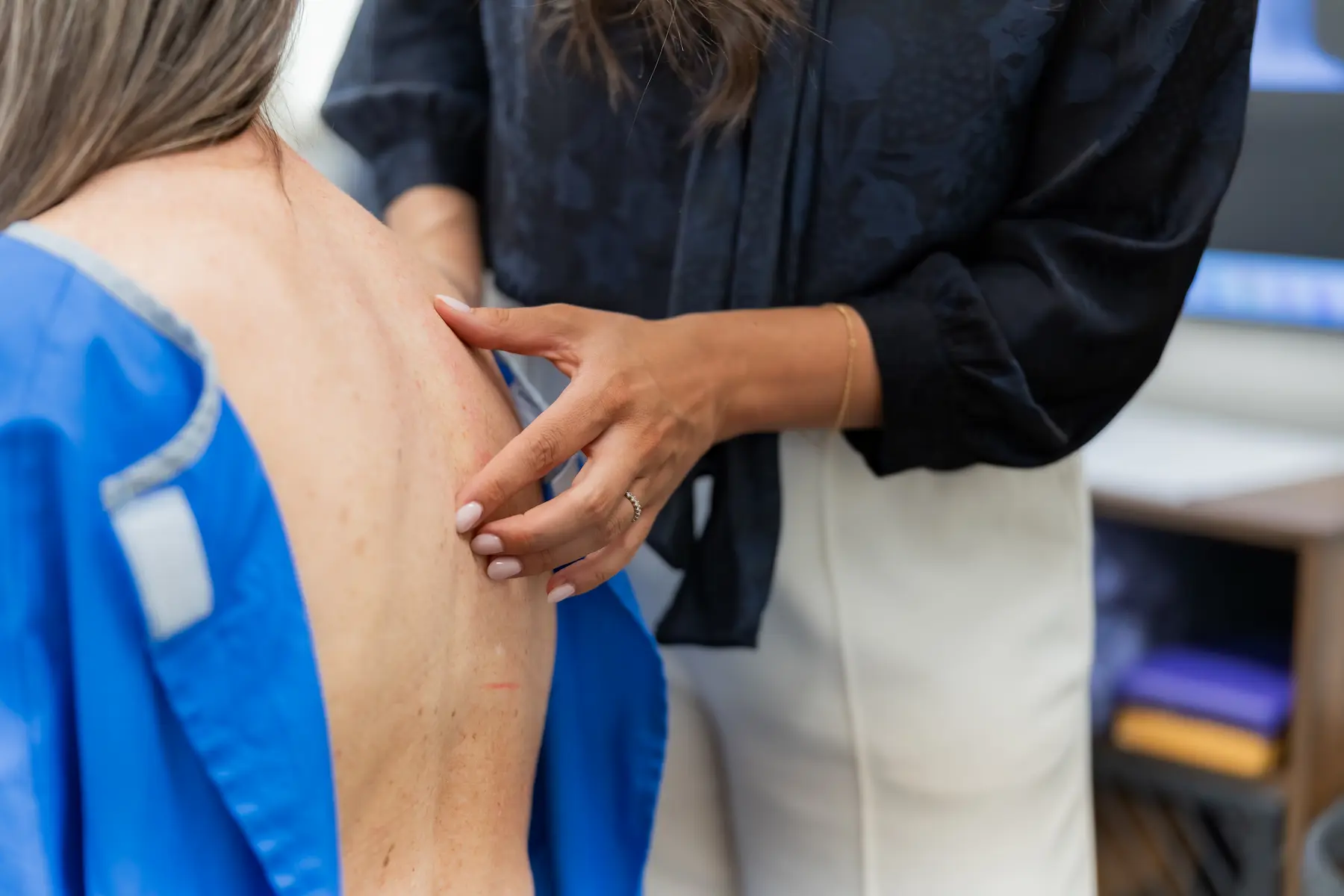
Specific Gonstead adjustments in scoliosis patients are directed at the segments causing the most functional interference – typically the rotated, fixated vertebrae that have lost normal motion and are contributing most significantly to nerve compression and muscle imbalance. The adjustments don’t change the curve architecture, but restoring motion to fixated segments and reducing nerve compression at key levels produces real functional improvement.
Adolescent Scoliosis: The Window That Matters
For adolescent scoliosis – typically identified during the middle and high school years – the stakes and the potential impact of chiropractic care are different than for adults.
Adolescent idiopathic scoliosis progresses most rapidly during the growth spurt, when rapid skeletal growth can accelerate curve development significantly. The standard medical approach for mild to moderate curves is observation – monitoring the curve at intervals with periodic X-rays and bracing if progression is significant. Surgery is reserved for severe or rapidly progressing curves.
Chiropractic care during this period is most valuable as a conservative complement to medical monitoring. By reducing the asymmetric spinal loading that drives curve progression – correcting the vertebral rotations and fixations that concentrate growth stress on one side of the disc and growth plate – chiropractic may help moderate the rate of progression in curves that are still in a malleable stage. The evidence for this is positive but still developing, and we present it honestly to families as a potentially useful conservative approach rather than a definitive treatment.
What is clearer is that adolescent patients under chiropractic care consistently report better mobility, reduced pain, and improved function – outcomes that matter regardless of what happens to the Cobb angle measurement. A teenager who moves well, hurts less, and participates fully in activity is a successful outcome even if the X-ray doesn’t show dramatic structural change.
Adult Degenerative Scoliosis
Degenerative scoliosis develops in adults – most commonly over age 50 – as years of asymmetric disc degeneration, facet joint arthritis, and vertebral settling create a lateral curve that wasn’t present in youth. It’s distinct from idiopathic scoliosis in that it’s a product of accumulated degeneration rather than a growth-related structural development.
For adults with degenerative scoliosis, the goals of chiropractic care are practical: reduce the pain from the degenerative facet joints and compressed discs, maintain whatever mobility remains in the affected segments, and improve quality of life within the constraints of a spine that has significant structural change. These are achievable goals, and many Southpark adults with degenerative scoliosis find consistent chiropractic maintenance to be one of the most effective tools available for keeping them functional and comfortable.
The approach is modified for the degenerative spine – lower force adjustments, careful attention to bone density, and conservative positioning – but the Gonstead principles of specific analysis and targeted correction remain the same.
What About Bracing and Exercise?
For adolescent patients with progressing curves, bracing as directed by an orthopedic specialist is a well-supported intervention and is not incompatible with chiropractic care. The two approaches work on different aspects of the problem – bracing controls curve progression externally, while chiropractic reduces the internal mechanical drivers of progression and addresses the neurological and functional consequences of the curve.
Exercise – specifically Schroth method physical therapy, which uses curve-specific exercises designed for scoliosis – is another valuable complement that we may discuss as part of a comprehensive management plan for appropriate patients. Core stability work that addresses the muscle imbalances created by the curve also supports chiropractic corrections and helps patients maintain better posture and function between visits.
Frequently Asked Questions
My curve is 15 degrees – is that worth treating?
Yes – particularly if it’s producing symptoms or if you’re an adolescent still in a growth phase. A 15-degree curve that’s causing pain, restricting movement, or showing signs of progression in a growing spine is worth actively managing. The most effective time to intervene is when the curve is small and functional, not after it has progressed to where options are more limited.
I was diagnosed with scoliosis as a teenager but never treated it – is it too late?
It’s not too late to address the functional consequences of an established curve. Adult patients with long-standing scoliosis often find significant relief from the pain, muscle tension, and restricted mobility associated with their curve through consistent chiropractic care – even when the curve itself isn’t going to change structurally. Quality of life improvement is a realistic and worthwhile goal at any age.
Do I need X-rays before starting care?
For scoliosis patients, yes – and this is non-negotiable. We need to know the degree of the curve, which levels are involved, the degree of vertebral rotation, and the overall structural picture before making any adjustments. Adjusting a scoliotic spine without full-spine X-rays is not appropriate clinical practice. Our full-spine Gonstead X-ray protocol gives us everything we need to develop a safe and specific care plan.
If you or your child has been diagnosed with scoliosis in Southpark and you’d like to understand what conservative chiropractic management can realistically offer, we’d be glad to talk through it. Call (704) 469-4772 or schedule a consultation at Axiom Chiropractic and let’s look at the X-rays together.
Axiom Chiropractic & Wellness Center serves Charlotte, NC and surrounding communities with expert Gonstead chiropractic care, advanced red light therapy, functional medicine, and specialized animal chiropractic. Led by Dr. Tyler Hartley and Dr. Megan Hullihen, we help families overcome back pain, neck pain, headaches, sciatica, and digestive issues through precise spinal corrections. Call (704) 469-4772 or schedule online to start your wellness journey today.