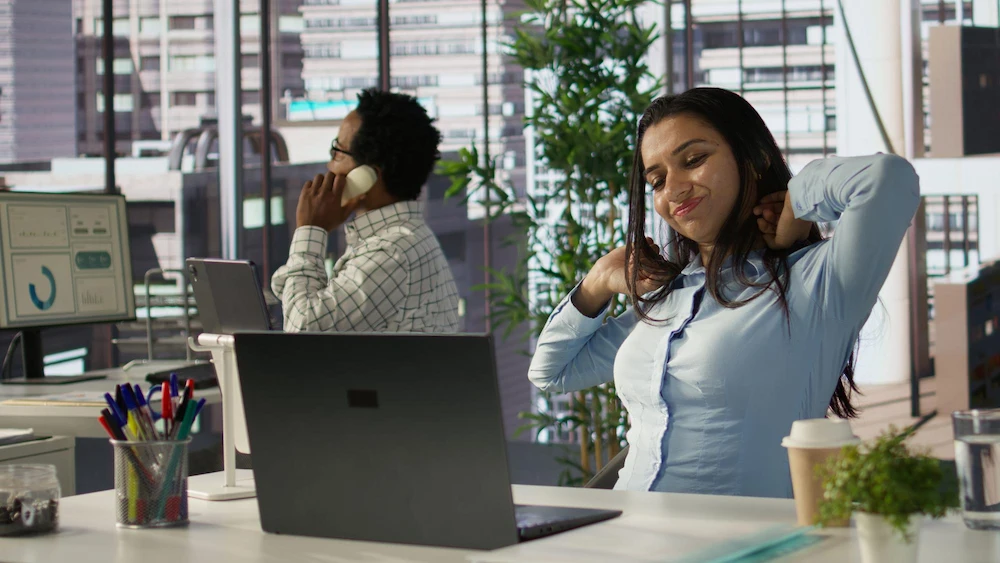
Tech neck is the progressive cervical spine damage caused by sustained forward head posture – the position most people hold for hours every day while looking at a screen. At Axiom Chiropractic in Southpark, desk workers make up a large portion of our patient base, and the cervical misalignment patterns we see from years of screen use are predictable, measurable, and in most cases very responsive to specific corrective care. The good news is that tech neck is not inevitable. The bad news is that it doesn’t fix itself.
What Tech Neck Actually Does to the Cervical Spine
The average adult head weighs 10 to 12 pounds in a neutral, balanced position directly over the shoulders. Move that head forward by two inches – which is typical for someone focused on a monitor or phone – and the effective load on the cervical spine jumps to roughly 30 to 40 pounds. Hold that position for six to eight hours a day, five days a week, and the structural consequences accumulate fast.
The cervical spine has a natural forward curve called the lordosis. This curve is not decorative – it’s the mechanical design that allows the neck to distribute compressive load efficiently and protect the spinal cord and nerve roots within it. Forward head posture progressively flattens and eventually reverses this curve. Once the lordosis is lost, every subsequent hour of screen time loads the cervical spine in a way it was never designed to handle.
The vertebrae most commonly misaligned from chronic tech neck are C4, C5, and C6 – the lower cervical levels where the forward shear force from a forward head is greatest, and where the nerve roots that supply the shoulders, arms, and hands exit the spine. This is why so many desk workers in Southpark experience not just neck pain and stiffness, but also shoulder tension, arm aching, numbness in the fingers, and headaches at the base of the skull – all from the same underlying cervical problem.
The Symptoms Desk Workers Normalize
One of the more frustrating aspects of tech neck is how gradually it develops. The symptoms sneak up over months and years, and most desk workers adjust their expectations downward along the way. By the time they seek care, they’ve typically been living with symptoms they’ve normalized for a long time.
The pattern we see most commonly in Southpark office workers:
Chronic upper trapezius tension that never fully releases despite massage, stretching, or exercise. The upper traps are compensating for a cervical spine that has lost its structural support – they can’t relax because the cervical misalignment is still loading them. Massage provides temporary relief because it addresses the muscle, not the cause.
Headaches at the base of the skull – suboccipital headaches that typically start at the back of the head and may radiate forward toward the eyes or temples. These are almost always cervicogenic in origin, driven by upper cervical misalignment irritating the suboccipital nerve roots that connect to the same brainstem structures that process head pain.
Intermittent arm tingling or numbness, often described as the arm “falling asleep” or a pins-and-needles sensation in the hand. This is cervical nerve root irritation – the lower cervical misalignments compressing the nerve roots that supply the arm, hand, and fingers.
End-of-day exhaustion that feels muscular, concentrated in the neck, upper back, and shoulders. This is the accumulated fatigue of postural muscles working all day to compensate for a structurally compromised cervical spine.
Reduced range of motion in the neck that develops so gradually it goes unnoticed until the person can’t comfortably check their blind spot while driving.
Why Stretching and Ergonomics Aren’t Enough
This is one of the most important things we tell new patients at Axiom: ergonomic improvements and daily stretching are genuinely useful for slowing the progression of tech neck, but they cannot correct the spinal misalignments that have already developed.
Raising your monitor to eye level reduces the forward head load while you’re at your desk. Stretching the neck through its range of motion daily maintains some mobility. These are good habits. But neither of them repositions a C5 vertebra that has shifted out of normal alignment. That requires a specific adjustment directed at that segment.
Think of it this way: if a wheel on your car is out of alignment, driving more carefully and inflating the tires properly will reduce the rate of uneven wear – but the alignment still needs to be corrected. The same logic applies to the cervical spine. Ergonomic habits manage the load. Chiropractic correction addresses the structural problem.
The Gonstead Approach to Tech Neck in Southpark
When a desk worker comes into Axiom with classic tech neck presentation, the first step is a complete Gonstead assessment – not just a look at the neck, but a full-spine picture.
Full-spine, weight-bearing X-rays are taken to evaluate the actual structural position of the cervical spine. We measure the degree of cervical lordosis (or its absence), the position of the head relative to the shoulders, and the specific vertebral levels that have shifted. These X-rays tell us exactly what we’re dealing with rather than adjusting based on where the patient hurts.
Nervoscope instrumentation scans for bilateral temperature asymmetry along the cervical spine – the objective signal of nerve irritation and inflammation at each level. In tech neck patients, this almost always shows significant findings in the lower cervical region where forward head loading is greatest.
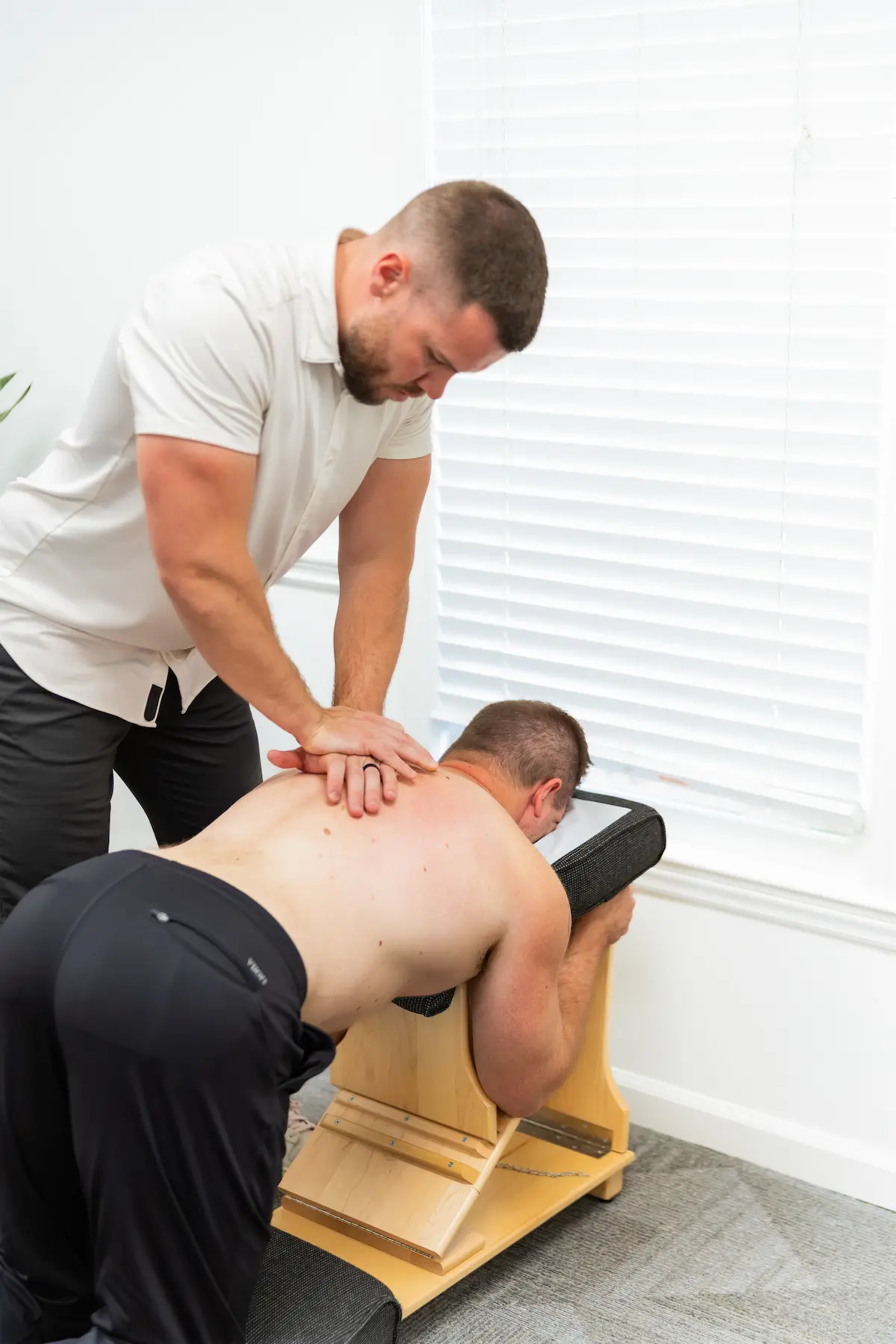
From there, specific Gonstead adjustments are directed at the misaligned cervical segments. No rotation of the neck, no generalized manipulation through the whole cervical region. The adjustment is precisely directed at the specific vertebra, with a specific line of drive and contact point calculated from the X-ray analysis.
Over the course of a care plan, we track changes objectively – both through repeat instrumentation scans and through patient-reported functional improvements. Many Southpark desk workers notice improvements in shoulder tension, headache frequency, and arm symptoms within the first few weeks of consistent care, with continued improvement as the cervical structure is progressively restored.
More detail on the full assessment and adjustment process is on our Gonstead chiropractic service page. If your symptoms include arm or hand involvement, our neck pain condition page covers the nerve pathways involved in more detail.
Practical Habits That Support Cervical Recovery
While chiropractic corrections address the structural problem, the habits around your workstation either support or work against the recovery. A few things that make a real difference:
Monitor height. The top third of your screen should be at or just below eye level when you’re sitting upright. Most people’s monitors are too low, which requires constant slight cervical flexion that adds up over hours.
Phone position. Holding the phone at chest height and looking down at it is one of the most damaging postures for the cervical spine. Raising the phone toward eye level when reading or scrolling is an easy change that meaningfully reduces cervical load.
Frequent position changes. No single posture, even a good one, is healthy when held for hours without interruption. Setting a reminder to stand, walk briefly, and move the neck through its range of motion every 30 to 45 minutes reduces the cumulative load and keeps cervical muscles from locking into fixed tension patterns.
Pillow height at night. The cervical spine shouldn’t be pushed into flexion during sleep. A pillow that keeps the head level with the spine in side-lying, or that supports the natural cervical curve in back-lying, prevents hours of nightly cervical stress that reverses daytime progress.
Frequently Asked Questions
How long does it take to reverse tech neck damage?
It depends on how long the pattern has been present and how much structural change has occurred. Early-stage tech neck – flattened lordosis with mild misalignment and minimal degeneration – can show meaningful structural improvement within several months of consistent care. Advanced cases with significant degeneration require longer care plans and have more limited reversal potential, though functional improvement is still very achievable. Your initial X-rays give us a realistic baseline for what to expect.
I work from home now – does that make my neck worse or better?
Often worse, because home setups tend to be ergonomically inferior to office setups. Laptops are particularly problematic – the screen is always too low when the keyboard is at a usable height. A separate monitor at proper height, an external keyboard, and a chair with adequate lumbar support make a significant difference for remote workers in Southpark whose tech neck has worsened since working from home.
Can I make adjustments hold if I’m still at a desk all day?
Yes – and many of our Southpark patients do exactly this. The key is consistency with both chiropractic care and workstation habits. Corrections hold better in patients who actively manage their ergonomics and movement patterns between visits. It’s not about eliminating screen time – it’s about reducing the cumulative structural load enough that the spine can maintain its corrected position between adjustments.
If you’re a desk worker in Southpark dealing with chronic neck tension, headaches, or arm symptoms that you’ve been managing rather than resolving, it’s time to look at what’s actually happening in the cervical spine. Call (704) 469-4772 or schedule a consultation at Axiom Chiropractic and let’s get an objective picture of where things stand.

Axiom Chiropractic & Wellness Center serves Charlotte, NC and surrounding communities with expert Gonstead chiropractic care, advanced red light therapy, functional medicine, and specialized animal chiropractic. Led by Dr. Tyler Hartley and Dr. Megan Hullihen, we help families overcome back pain, neck pain, headaches, sciatica, and digestive issues through precise spinal corrections. Call (704) 469-4772 or schedule online to start your wellness journey today.