
If you’ve been treating wrist pain, tingling fingers, or hand numbness without lasting relief, the real source may be in your neck rather than your wrist. The nerves that control your hand and fingers travel all the way from your cervical spine, through your shoulder and arm, down to your wrist. When those nerves are irritated at the neck, the symptoms often show up in the hand, which is why so many people in Southpark spend months treating the wrong location. At Axiom Chiropractic, we regularly find that wrist and hand symptoms trace back to a cervical spine problem.
The Nerve Pathway From Neck to Hand
The nerves that supply your hand don’t originate in your hand. They start at the lower cervical spine – levels C5 through C8 and the first thoracic vertebra, T1. From there, they bundle together into a network called the brachial plexus, travel through the shoulder, run down the arm, pass through the wrist, and finally reach the fingers.
That’s a long journey, and the nerve can be compressed or irritated at any point along the way. The wrist is one possible site – that’s what classic carpal tunnel syndrome involves, compression of the median nerve as it passes through the carpal tunnel at the wrist. But the neck is another site entirely, and it’s frequently overlooked.
When a cervical vertebra at C6 or C7 is misaligned, it can irritate the nerve root exiting at that level – the same nerve that eventually supplies part of the hand. The brain interprets the signal as coming from where the nerve ends, not where it’s actually being compressed. So the symptoms appear in the wrist and fingers even though the problem is six inches higher, at the neck.
The Double Crush Phenomenon
Here’s where it gets clinically interesting. There’s a well-documented concept called “double crush syndrome,” and it explains a lot of stubborn wrist pain cases.
The idea is that a nerve compressed at one point along its path becomes more vulnerable to dysfunction at a second point. If the nerve is already irritated at the cervical spine, even a minor amount of additional pressure at the wrist can tip it into producing significant symptoms. Neither compression alone would necessarily cause the problem, but together they do.
This explains why some people have wrist surgery for carpal tunnel and still have symptoms afterward. The wrist compression was addressed, but the cervical component was never identified or treated. The nerve is still being irritated at the neck, so the hand symptoms persist or return.
It also explains why treating only the wrist with braces, anti-inflammatories, or injections sometimes produces only partial relief. If half the problem is at the neck, treating only the wrist leaves half the problem in place.
How to Tell Where Your Symptoms Are Coming From
Certain patterns suggest the neck is involved in hand and wrist symptoms:
Symptoms that involve more than just the wrist. True carpal tunnel typically affects the thumb, index, middle, and part of the ring finger – the median nerve distribution. If your symptoms include the pinky finger, the back of the hand, or extend up the forearm toward the elbow and shoulder, that points toward a cervical origin rather than pure wrist compression.
Neck or shoulder tension that accompanies the hand symptoms. When hand tingling shows up alongside chronic neck stiffness, shoulder tension, or upper back tightness, those are often connected expressions of the same cervical problem.
Symptoms that change with neck position. If turning your head, looking up, or holding certain neck positions changes the hand symptoms, that’s a strong signal the nerve is being affected at the neck.
Symptoms in both hands. Bilateral hand symptoms can occur with carpal tunnel, but they more often suggest a central source like the cervical spine affecting nerve supply to both arms.
Hand symptoms that didn’t respond to wrist treatment. If you’ve tried wrist braces, ergonomic changes, and anti-inflammatories without lasting relief, the cervical component is worth investigating.
What We Look For at Axiom
When a Southpark patient comes in with wrist, hand, or finger symptoms, we don’t just look at the wrist. We assess the entire nerve pathway, with particular attention to the cervical spine.
Full-spine, weight-bearing X-rays show the structural position of the lower cervical vertebrae – the levels that supply the arm and hand. We’re looking for misalignment, loss of the normal cervical curve, disc space narrowing, and any structural change that could be irritating the nerve roots at C5 through T1.
Nervoscope instrumentation scans the cervical spine for bilateral temperature asymmetry, which identifies where nerve irritation and inflammation are present. In patients whose hand symptoms have a cervical origin, this almost always shows findings in the lower cervical region.
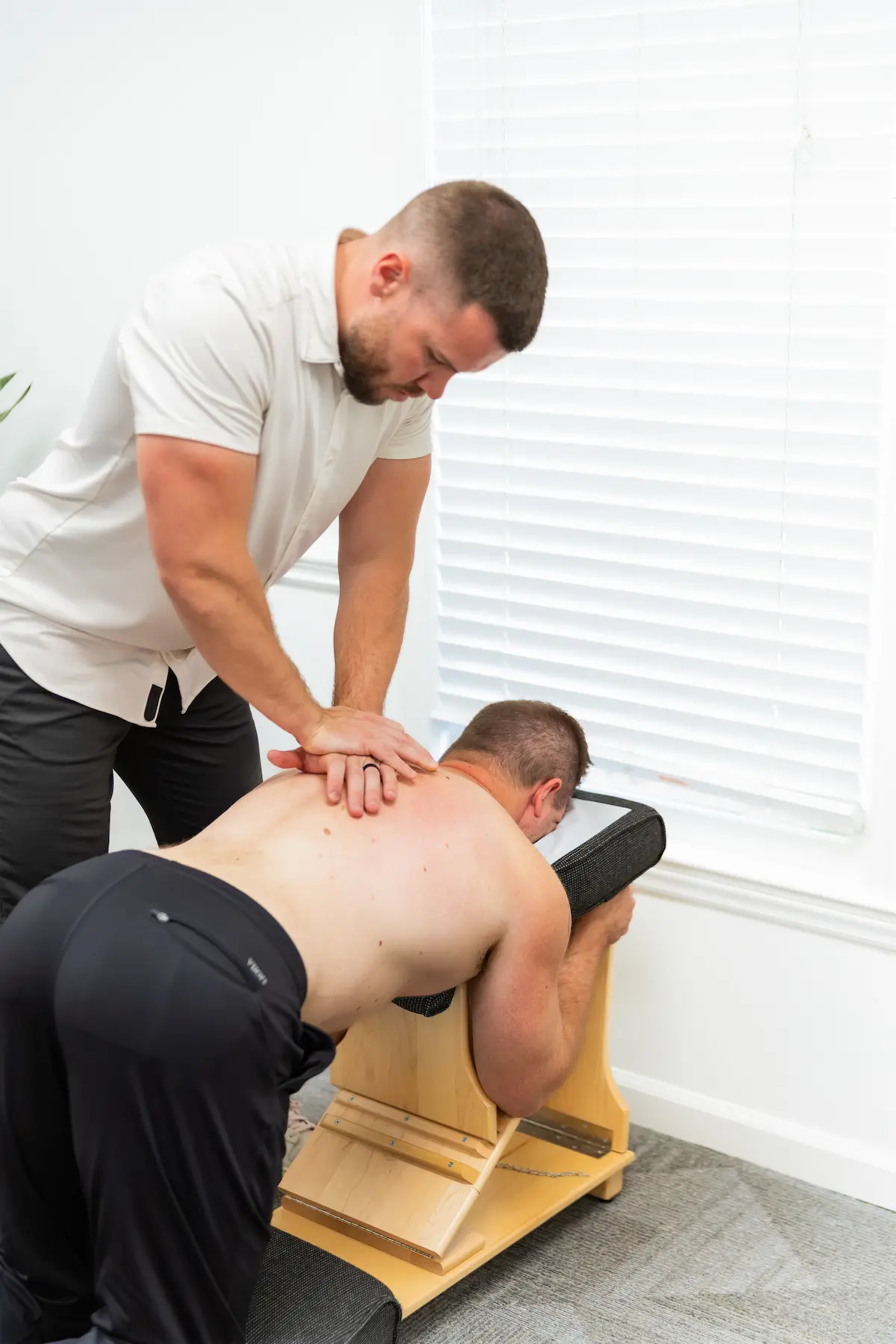
From there, specific Gonstead chiropractic adjustments are directed at the misaligned cervical segments – restoring normal position and motion to relieve the nerve irritation at its source. We also assess the shoulder, elbow, and wrist along the nerve pathway, since the double crush concept means more than one site may need attention.
Our neck pain page covers the cervical nerve pathways in more detail, and our extremity pain page explains how spinal problems contribute to symptoms in the arms, hands, and other extremities.
Why Desk Workers Are Especially Affected
The combination that drives so many wrist and hand problems in Southpark office workers is a perfect storm: forward head posture loading the lower cervical spine all day, plus sustained wrist positioning at a keyboard and mouse.
The forward head posture irritates the cervical nerve roots that supply the hand. The repetitive wrist positioning adds compression at the carpal tunnel. Together, they create exactly the double crush scenario that produces persistent, frustrating hand symptoms – and that doesn’t fully respond to addressing either site alone.
This is why ergonomic changes at the workstation help but often don’t completely resolve the problem. They reduce the wrist component, but the cervical component continues until the neck is addressed. Correcting the cervical misalignment alongside good wrist ergonomics is what produces lasting relief for most desk workers.
Frequently Asked Questions
I was already diagnosed with carpal tunnel. Does that mean it’s not my neck?
Not necessarily. A carpal tunnel diagnosis confirms there’s compression at the wrist, but it doesn’t rule out a simultaneous cervical component. Many people have both. If your symptoms haven’t fully responded to wrist-focused treatment, the cervical spine is worth assessing as a possible contributor that was never evaluated.
Can chiropractic help if I’ve already had carpal tunnel surgery?
Possibly, if a cervical component was never addressed. Some people continue to have hand symptoms after surgery because the wrist was treated but the nerve irritation at the neck remained. A cervical assessment can determine whether there’s an unaddressed source still contributing to your symptoms.
How long before hand symptoms improve with cervical care?
It varies depending on how long the nerve has been irritated and how significant the cervical misalignment is. Some patients notice changes in the first few weeks of care. Nerve recovery can take longer than pain relief, since the nerve itself needs time to settle once the pressure is relieved. We track progress objectively so you know whether things are moving in the right direction.
If wrist or hand symptoms have been frustrating you and the usual treatments haven’t worked, the answer may be higher up than you think. Call (704) 469-4772 or schedule a consultation at Axiom Chiropractic in Southpark and let’s find out where your symptoms are really coming from.

Axiom Chiropractic & Wellness Center serves Charlotte, NC and surrounding communities with expert Gonstead chiropractic care, advanced red light therapy, functional medicine, and specialized animal chiropractic. Led by Dr. Tyler Hartley and Dr. Megan Hullihen, we help families overcome back pain, neck pain, headaches, sciatica, and digestive issues through precise spinal corrections. Call (704) 469-4772 or schedule online to start your wellness journey today.