
A pinched nerve and a muscle knot can both cause pain in similar areas, but they’re very different problems with different causes and different solutions. Knowing which one you’re dealing with matters, because treating a pinched nerve like a muscle knot, or vice versa, often means the pain never fully resolves. At Axiom Chiropractic in Southpark, patients frequently come in unsure which they have, and sorting that out is one of the first things we help with.
What a Muscle Knot Actually Is
A muscle knot, known clinically as a myofascial trigger point, is a tight, contracted band within a muscle. When a portion of muscle fibers stays contracted and won’t fully relax, it forms a tender, often palpable knot. You can frequently feel it as a firm lump or band in the muscle, and pressing on it usually reproduces or intensifies the discomfort.
Muscle knots develop from overuse, sustained poor posture, stress-related tension, or compensating for an underlying problem elsewhere. The pain from a knot is typically a deep, achy, sore sensation. It can refer, meaning it can create pain in a nearby area, but it tends to stay relatively regional rather than shooting long distances.
What a Pinched Nerve Actually Is
A pinched nerve happens when a nerve is compressed or irritated, often where it exits the spine between two vertebrae. When a vertebra is misaligned or a disc is bulging, it can press on or irritate the nerve root at that level. The nerve then sends abnormal signals, and the symptoms can travel a long way along the nerve’s path.
The quality of pinched nerve pain is distinct. Instead of a deep ache, it’s often described as sharp, shooting, burning, or electric. It frequently comes with neurological symptoms that a muscle knot doesn’t produce: numbness, tingling, a pins-and-needles sensation, or even weakness in the area the nerve supplies. And it tends to radiate, traveling down an arm or leg rather than staying local.
How to Tell the Difference
Here are the key distinctions that help identify which problem you’re dealing with.
The Quality of the Pain
A muscle knot produces a deep, dull, achy, sore feeling. A pinched nerve produces sharp, shooting, burning, or electric pain. If your pain feels like an ache you want to dig into and massage, that points toward a muscle knot. If it feels like a sharp jolt or a burning line, that points toward a nerve.
Whether There Are Neurological Symptoms
This is one of the clearest differentiators. Numbness, tingling, pins-and-needles, and weakness are hallmarks of nerve involvement. Muscle knots don’t cause true numbness or tingling. If you have any of these neurological symptoms alongside your pain, a nerve is likely involved.
Whether the Pain Travels
Muscle knot pain stays relatively regional. Pinched nerve pain often radiates along the nerve’s path, traveling down the arm into the hand, or down the leg into the foot. Pain that shoots or travels a significant distance from its origin suggests a nerve. Pain that stays put in one muscular area suggests a knot.
Whether You Can Feel a Knot
You can often physically feel a muscle knot as a tight, tender lump or band in the muscle, and pressing it reproduces the pain. A pinched nerve typically doesn’t have a palpable lump at the site, and the pain isn’t necessarily reproduced by pressing on one specific spot the way a trigger point is.
What Makes It Better or Worse
Muscle knots often respond, at least temporarily, to massage, heat, and stretching. Pinched nerves can actually be aggravated by aggressive massage or certain stretches, and the symptoms often change with specific positions or movements, particularly movements of the spine that increase or decrease pressure on the nerve.
The Catch: They Often Happen Together
Here’s what makes this genuinely tricky. Pinched nerves and muscle knots frequently coexist, and one can cause the other.
When a nerve is pinched at the spine, it can cause the muscles it supplies to become tight, dysfunctional, and prone to forming knots. So you can have a pinched nerve at the root of the problem, and muscle knots developing downstream as a result. In this scenario, treating only the muscle knots, with massage after massage, provides temporary relief but never resolves the issue, because the pinched nerve causing the muscle dysfunction is still there.
This is exactly why so many people get repeated massages for a stubborn knot that always comes back. If a pinched nerve is driving the muscle tension, the knot will keep returning until the nerve compression is addressed. The massage feels good and helps briefly, but it’s treating the symptom of a deeper problem.
Conversely, severe muscle tension can sometimes contribute to nerve irritation. The two are interconnected, which is why proper assessment matters rather than assuming it’s one or the other.
How We Sort It Out at Axiom
When a Southpark patient comes in with pain that could be either a pinched nerve or a muscle knot, our assessment is designed to identify exactly what’s happening and where.
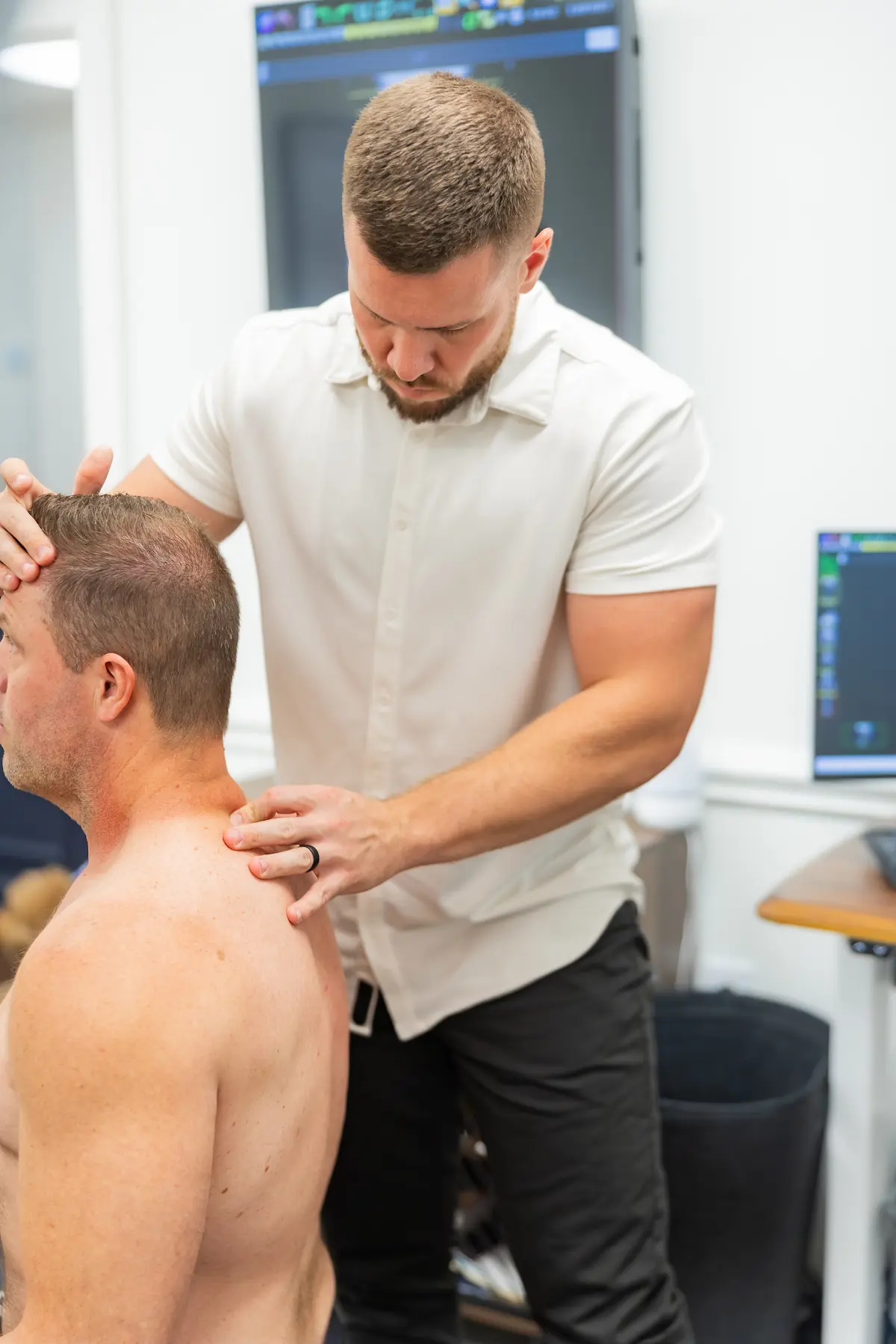
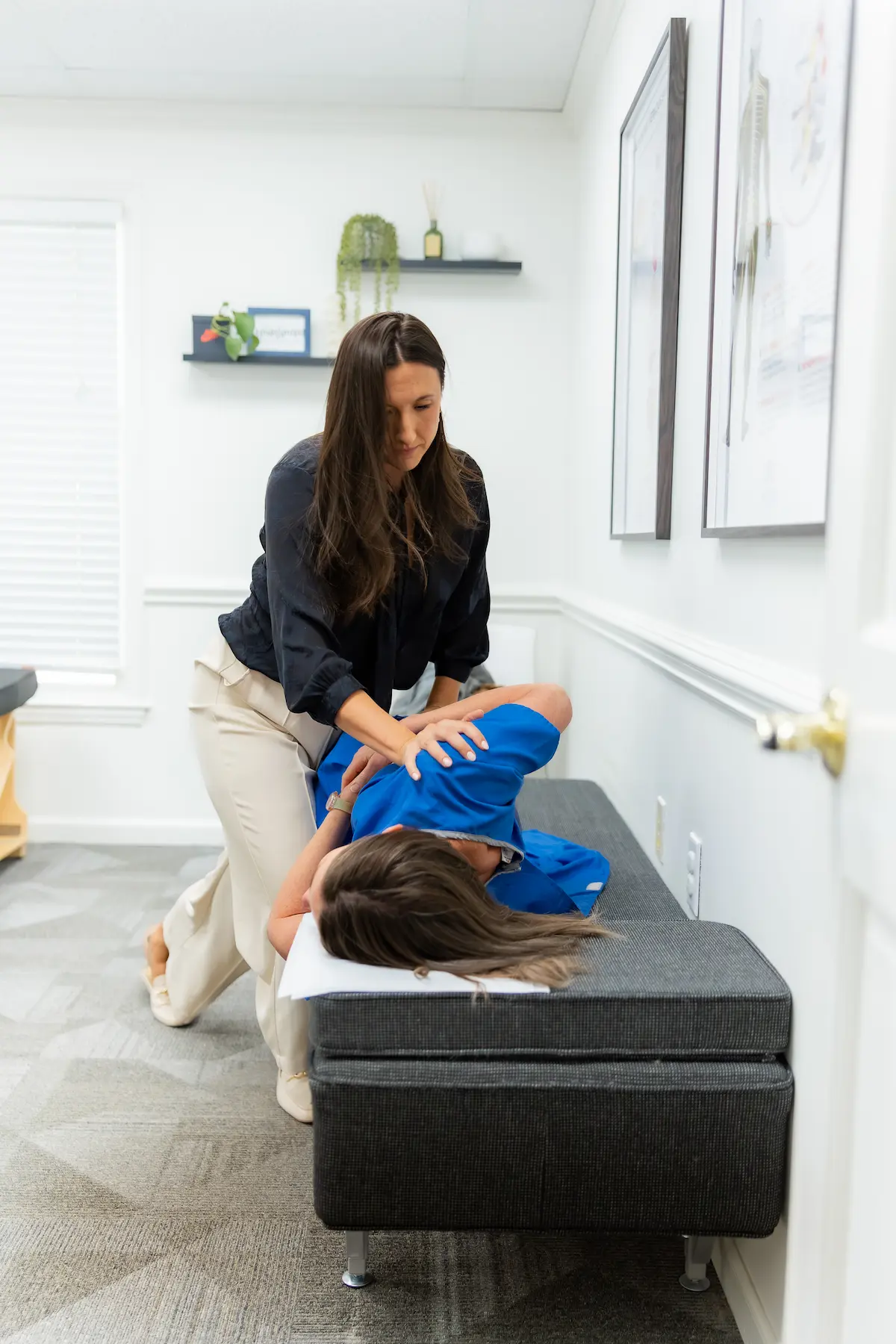
We start with a detailed history of your symptoms, the quality of the pain, whether there’s numbness or tingling, whether it radiates, and what makes it better or worse, all of which help distinguish nerve involvement from purely muscular pain. Full-spine, weight-bearing X-rays show whether there’s spinal misalignment or disc involvement that could be compressing a nerve root. Nervoscope instrumentation identifies areas of nerve irritation and inflammation along the spine. Palpation assesses both the spinal segments and the muscle tissue, identifying restricted joints and the muscle knots that may have developed around them.
This combination tells us whether you’re dealing with a pinched nerve, muscle knots, or, as is often the case, both, with one driving the other. From there, specific Gonstead chiropractic adjustments address any nerve compression at its source by correcting the misaligned segment, which also relieves the muscle dysfunction that the nerve irritation was causing. When the root cause is addressed, the downstream muscle knots often resolve and stop coming back.
For more on how nerve compression works, our neck pain page and back pain page cover the mechanisms involved, and our post on wrist pain coming from the neck is a good example of how a pinched nerve can produce symptoms far from its source.
Why Getting This Right Matters
The practical reason this distinction matters so much is that the wrong approach wastes time and money while the problem persists. Endless massage for what’s actually a pinched nerve will never resolve it. Aggressive stretching of what’s actually nerve irritation can make it worse. Identifying which problem you have, and whether both are present, is what allows for treatment that actually works rather than just temporarily soothes.
Frequently Asked Questions
Can a massage therapist fix a pinched nerve?
Massage can help relax the muscle tension that often accompanies a pinched nerve and may provide temporary relief, but it doesn’t address the nerve compression itself if that’s happening at the spine. If a misaligned vertebra or disc is compressing the nerve, that structural issue needs to be corrected. Massage and chiropractic care can work well together, but massage alone usually isn’t enough for a true pinched nerve.
How do I know if my knot is from a nerve problem?
A few clues: if the knot keeps coming back no matter how much you massage or stretch it, if it’s accompanied by any numbness, tingling, or radiating pain, or if it’s in an area supplied by a nerve from a part of your spine that’s also bothering you. The most reliable way to know is a proper assessment that evaluates both the muscle and the spinal segments that could be involved.
Could it really be both at the same time?
Yes, and it commonly is. A pinched nerve at the spine often causes the muscles it supplies to tighten and form knots. In these cases you’ll have both a nerve problem and muscle knots, with the nerve being the root cause. This is why treating only the muscles doesn’t fully resolve it, the underlying nerve compression has to be addressed too.
If you’re not sure whether you’re dealing with a pinched nerve, a muscle knot, or both, getting a clear answer is the first step toward actually fixing it. Call (704) 469-4772 or schedule a consultation at Axiom Chiropractic in Southpark and let’s figure out exactly what’s going on.
Axiom Chiropractic & Wellness Center serves Charlotte, NC and surrounding communities with expert Gonstead chiropractic care, advanced red light therapy, functional medicine, and specialized animal chiropractic. Led by Dr. Tyler Hartley and Dr. Megan Hullihen, we help families overcome back pain, neck pain, headaches, sciatica, and digestive issues through precise spinal corrections. Call (704) 469-4772 or schedule online to start your wellness journey today.