
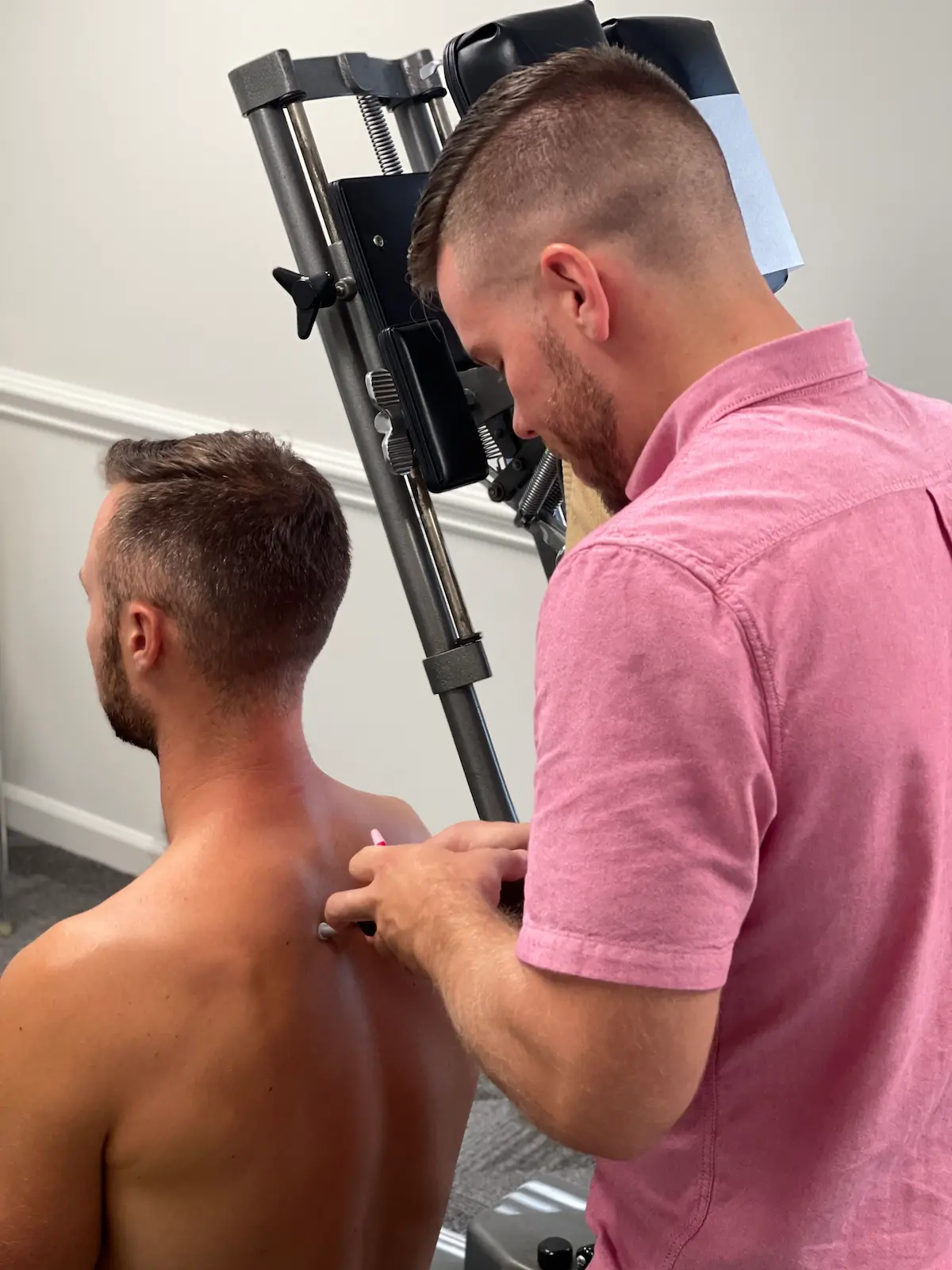
If you’ve had chiropractic care that helped temporarily but never produced lasting change, you’re not imagining the pattern – and it’s not because chiropractic doesn’t work. In most cases, short-lived results come down to one of a few specific, identifiable reasons: the wrong segment was being adjusted, the root cause was never fully identified, the care plan was cut short, or the biochemical environment was working against structural correction. At Axiom Chiropractic in Southpark, understanding why results didn’t last elsewhere is often the most important part of helping a patient finally get somewhere.
Reason 1: The Wrong Segment Was Being Adjusted
This is the most common reason chiropractic results don’t hold – and it’s entirely a function of technique and assessment depth.
Pain is not always located at the spinal level causing the problem. A patient with significant nerve irritation at C5 may feel it primarily in their shoulder. A patient with the real driver of their sciatica at L4 may point to their hip. A patient whose lower back pain is being perpetuated by thoracic fixation may have had their lumbar spine adjusted repeatedly without ever addressing the actual source.
When adjustments are delivered based on where symptoms are or where restriction is palpable – without objective analysis of the full-spine structural picture – it’s entirely possible to spend months adjusting segments that don’t need correction while leaving the actual problem untouched. The patient feels some relief because any spinal mobilization has some short-term effect on local tension and fluid dynamics. But the underlying misalignment that’s generating the nerve interference continues, and the symptoms return.
The Gonstead method resolves this through the five-criteria assessment – full-spine weight-bearing X-rays, instrumentation scanning, static and motion palpation, visualization, and case history correlation. The adjustment happens at the level the objective findings identify, not where the patient hurts. This is the single biggest reason patients who’ve had unsatisfying results with general chiropractic find a different experience with Gonstead care at Axiom.
Reason 2: Symptoms Were Treated but the Structure Wasn’t Corrected
There’s an important distinction between reducing symptoms and correcting structural misalignment – and most patients don’t realize these are two different outcomes.
An adjustment to a fixated spinal segment can reduce local inflammation, restore some joint motion, and produce pain relief that lasts days to weeks. This is a real and worthwhile outcome. But it isn’t the same as repositioning a vertebra that has shifted out of its correct structural position and restoring the long-term stability needed to keep it there.
Structural correction requires consistent, progressive care delivered over a sufficient time frame – typically weeks to months depending on the degree and duration of the misalignment. The connective tissue around a chronically misaligned vertebra adapts to hold it in its displaced position. Ligaments shorten on one side and lengthen on the other. Muscles develop habitual tension patterns that pull toward the misaligned position. Reversing those adaptations takes repeated, specific corrections over time.
Many patients stop care as soon as symptoms improve – often after just a few visits. The pain is gone, so the problem feels solved. But if the structural correction hasn’t been completed, the underlying misalignment is still present. The tissue that was inflamed has calmed down, but the vertebral position hasn’t changed enough to hold on its own. Within days to weeks of stopping care, the misalignment reasserts itself, the nerve irritation returns, and the symptoms come back.
This is why we build care plans at Axiom based on objective structural findings, not just symptom reports. And why we use repeat instrumentation scans and periodic re-examinations throughout a care plan – to track actual structural change, not just how the patient feels on a given day.
Reason 3: The Full Spine Wasn’t Assessed
Most chiropractic practices assess the region of the spine closest to where the patient hurts. Neck pain gets a cervical assessment. Low back pain gets a lumbar assessment. This seems logical, but it misses a fundamental truth about spinal mechanics: every region of the spine influences every other region.
A lumbar misalignment creates compensatory changes in the thoracic spine above it. A thoracic fixation alters the mechanical demands on the cervical spine. The pelvis is the foundation everything above sits on – a pelvic misalignment changes how load is distributed all the way up through the lumbar, thoracic, and cervical regions.
Treating only the symptomatic region while the structural drivers above or below it go unaddressed means working against the body’s compensation patterns. The cervical adjustment that doesn’t hold may be fighting a postural adaptation driven by a lumbar or thoracic problem that was never identified.
Full-spine, weight-bearing X-rays – standard in every Gonstead assessment at Axiom – give us the complete structural picture before making any adjustment. We see how each region of the spine is positioned relative to the others, which tells us where the primary drivers are versus where the compensations are. Adjusting primary drivers rather than compensations is one of the most important reasons Gonstead results tend to be more durable.
Reason 4: The Biochemical Environment Was Working Against Healing
This one surprises people. Spinal corrections are structural interventions, but they depend on biological tissue to hold their position. If that tissue is compromised – by hormonal imbalance, nutrient deficiency, systemic inflammation, or chronic stress – structural corrections may produce less lasting change than they should.
Vitamin D deficiency impairs collagen synthesis in the ligaments and discs that stabilize spinal segments. Chronically elevated cortisol breaks down connective tissue faster than it repairs. Low thyroid function slows tissue healing across the board. High systemic inflammation keeps the nervous system sensitized, maintaining muscle tension that pulls misaligned segments back toward their displaced position even after correction.
Patients whose adjustments consistently revert faster than expected are often dealing with one or more of these biochemical contributors. Our functional medicine blood work service identifies these patterns specifically – using functional optimal ranges rather than broad disease-threshold ranges that miss the suboptimal zone where patients are genuinely affected but technically “normal.”
Addressing the biochemical environment alongside structural correction is one of the most powerful combinations available. The adjustment creates the right mechanical position. The functional medicine protocol creates the biological conditions for that position to hold.
Reason 5: The Care Plan Ended Too Soon
We mentioned this above in the context of stopping care when symptoms improve, but it deserves its own section because it’s so common and so consequential.
Structural spinal correction follows a predictable arc. The initial phase – typically the first several weeks – focuses on reducing acute nerve irritation, restoring motion to fixated segments, and beginning to reposition misaligned vertebrae. Patients often feel significantly better during this phase.
But structural correction isn’t complete when pain resolves. The connective tissue adaptations that were holding the misalignment in place are still present. The postural muscle habits are still pulling toward the old position. The spinal segments are in a better position but not yet stable enough to hold without continued correction.
The stabilization phase – continuing care after initial symptom relief – is where the structural changes are consolidated. This is when the ligamentous and muscular adaptations are progressively reversed, and the corrected vertebral positions become stable enough to persist without constant reintroduction.
Patients who complete their full care plan and transition to maintenance care hold their results. Patients who stop at the point of symptom relief – before stabilization is complete – almost always experience recurrence. Not because chiropractic failed, but because the process was interrupted before it finished.
How We Approach This at Axiom
When a new patient comes to us in Southpark with a history of temporary results from previous chiropractic care, the first thing we do is run a complete Gonstead assessment. Full-spine X-rays, instrumentation scanning, palpation, posture analysis – the full picture before any adjustment is made.
We look at where the actual structural drivers are, not just where they’ve been treated before. We review the previous care history with the patient to understand what was adjusted, what improved, and what kept coming back. And we build a care plan based on objective findings with realistic timelines and measurable goals.
Progress is tracked objectively throughout – with repeat instrumentation scans and re-examinations at scheduled intervals. Patients see their own data changing over time, which makes the care plan feel grounded rather than open-ended.
More detail on how the full assessment and correction process works is on our Gonstead chiropractic service page.
Frequently Asked Questions
How long should a proper chiropractic care plan actually take?
It depends on the degree of misalignment, how long it’s been present, the patient’s age and tissue quality, and whether there are biochemical factors slowing healing. Mild, recent misalignments may stabilize in six to eight weeks of consistent care. Significant, long-standing structural problems often require three to six months or longer. We give each patient a realistic timeline estimate after the initial assessment – not a guess, but a projection based on what we find.
What does maintenance care look like after the correction phase?
Maintenance care is typically less frequent than the correction phase – often monthly or every few weeks depending on the patient’s structural stability and lifestyle demands. The goal is to catch and correct new misalignments before they become symptomatic and to preserve the structural corrections achieved during the initial care plan. Most patients find that consistent maintenance keeps them functioning at a level they couldn’t sustain without it.
What if I can only commit to a short care plan right now?
We work with patients’ realities. If time or financial constraints limit the care plan, we focus on the primary structural drivers and the most important corrections – and we’re honest about what’s likely to hold and what may recur. Something is better than nothing, and even partial structural correction can produce meaningful functional improvement. We just want patients to have realistic expectations going in.
If your chiropractic results have consistently worn off faster than you hoped, it’s worth finding out why before writing off chiropractic entirely. Call (704) 469-4772 or schedule a consultation at Axiom Chiropractic in Southpark and let’s take an honest look at what’s been driving the pattern.

Axiom Chiropractic & Wellness Center serves Charlotte, NC and surrounding communities with expert Gonstead chiropractic care, advanced red light therapy, functional medicine, and specialized animal chiropractic. Led by Dr. Tyler Hartley and Dr. Megan Hullihen, we help families overcome back pain, neck pain, headaches, sciatica, and digestive issues through precise spinal corrections. Call (704) 469-4772 or schedule online to start your wellness journey today.