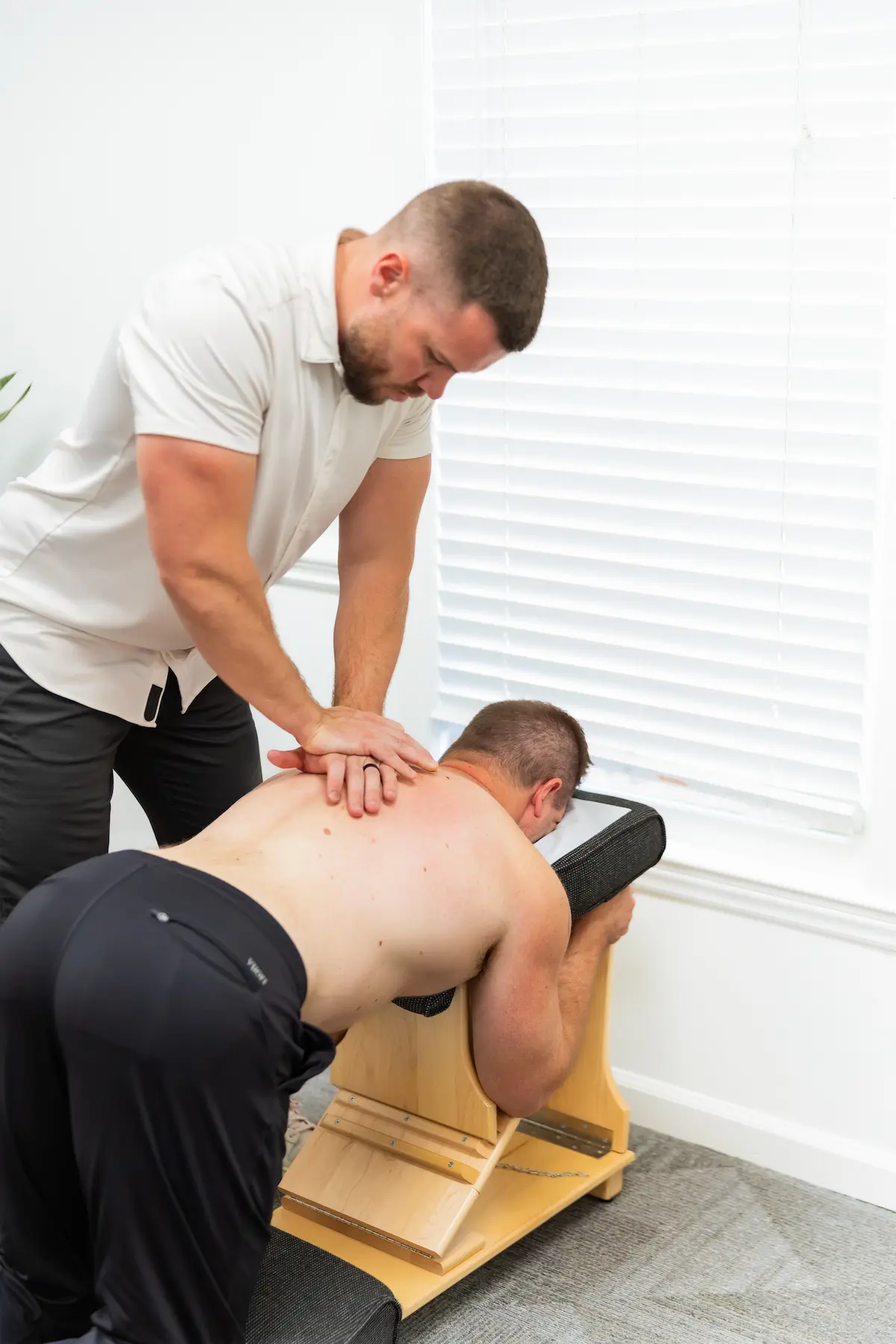

If you’re in pain and trying to decide between a chiropractor and a physical therapist, the honest answer is that they do different things, and the right choice depends on what’s actually causing your problem. A chiropractor focuses on correcting spinal misalignments and restoring proper joint function to remove nerve interference, while a physical therapist focuses on rehabilitating movement through targeted exercise and manual therapy. At Axiom Chiropractic in Charlotte, we help patients understand the difference so they can make the right call, and sometimes that means recognizing you need both.
What a Chiropractor Does
Chiropractic care centers on the relationship between your spine and your nervous system. The core idea is that when vertebrae are misaligned, they can irritate the nerves exiting the spine and disrupt how your body functions, creating pain and dysfunction that may show up locally or somewhere else entirely.
A chiropractor’s primary tool is the adjustment, a specific, controlled correction directed at a misaligned or restricted spinal segment to restore proper position and motion. The goal is to remove the nerve interference at its source, which allows the body to function and heal more normally.
At Axiom, we use the Gonstead method, which is among the most precise and thorough approaches in chiropractic. Before any adjustment, we assess with full-spine weight-bearing X-rays, Nervoscope instrumentation, palpation, and postural analysis to identify exactly which segments need correction. The adjustment is then delivered specifically to those segments rather than through general manipulation.
Chiropractic care is often the right starting point when the underlying issue involves spinal misalignment, nerve compression, or joint dysfunction, things like back pain, neck pain, sciatica, headaches, and the wide range of issues that stem from nervous system interference.
What a Physical Therapist Does
Physical therapy focuses on restoring movement, strength, and function, usually through prescribed exercises, stretching, and manual techniques. Physical therapists are movement specialists who help patients recover after injuries, surgeries, or conditions that have left them with weakness, limited range of motion, or functional deficits.
A physical therapist typically develops a program of progressive exercises designed to strengthen weak muscles, improve flexibility, retrain movement patterns, and build the stability needed to support recovery. Their work is often especially valuable in post-surgical rehabilitation, recovery from significant injuries, and building strength around a joint or region that has become deconditioned.
Where a chiropractor is focused on correcting the structural and neurological source of a problem, a physical therapist is focused on rebuilding the strength and movement capacity around it.
Where They Overlap
There’s genuine overlap between the two, which is part of why people find the choice confusing. Both address musculoskeletal pain. Both use hands-on manual techniques. Both aim to improve how your body moves and functions. Both can help with common complaints like back and neck pain.
The overlap is real, but the underlying philosophy and primary approach differ. A chiropractor asks, what’s structurally misaligned and causing nerve interference, and how do we correct it. A physical therapist asks, what’s weak, tight, or moving poorly, and how do we rehabilitate it through exercise and movement.
Which One Do You Actually Need?
Here’s a practical way to think about it.
Chiropractic tends to be the better fit when your problem involves spinal misalignment or nerve-related symptoms, sharp or radiating pain, numbness or tingling, pain that keeps coming back, headaches linked to the neck, or issues that seem connected to how your spine is functioning. If your pain has a clear nerve or structural quality, addressing the source through adjustment is often what’s needed.
Physical therapy tends to be the better fit when you’re recovering from surgery, rehabilitating a significant injury like a torn ligament or a major muscle strain, or dealing with weakness and functional deficits that require a structured strengthening program to rebuild.
You may need both when a structural problem needs correcting and there’s also significant weakness or movement dysfunction to rebuild. For example, correcting a spinal misalignment with chiropractic care removes the underlying driver, while physical therapy or rehabilitation exercises rebuild the strength and stability to support the correction and prevent recurrence. The two approaches aren’t in competition, and in many cases they work extremely well together.
How We Think About It at Axiom
Our approach in Charlotte is to identify the actual source of your problem first. The full Gonstead assessment, with X-rays, instrumentation, and palpation, tells us whether spinal misalignment and nerve interference are driving your symptoms, and if so, exactly where.
If your problem is structural and neurological, chiropractic care addresses it at the source. If we find that you’d also benefit from strengthening and movement rehabilitation, we’re honest about that and will discuss incorporating appropriate exercise or, when warranted, working alongside a physical therapist. We’re not interested in being the only answer, we’re interested in you getting the right care for what’s actually going on.
For patients dealing with issues like back pain that keeps returning, understanding whether the root cause is structural, muscular, or both is exactly what determines the right path. Treating a structural misalignment with exercise alone, or trying to strengthen your way out of a nerve compression problem, often leaves people frustrated with incomplete results.
The Bottom Line
Neither profession is universally better, they’re built for different purposes. A chiropractor corrects the structural and neurological source of a problem. A physical therapist rebuilds strength and movement. The right choice depends on what’s causing your specific issue, and sometimes the best outcome comes from both working together. What matters most is getting an accurate understanding of what’s actually driving your pain, so you’re not spending time and money on the wrong approach.
Frequently Asked Questions
Can I see a chiropractor and a physical therapist at the same time?
Yes, and in many cases the combination works well. Chiropractic care corrects the structural and neurological source of a problem while physical therapy rebuilds strength and movement around it. As long as both providers understand what the other is doing, the approaches complement each other. We’re happy to coordinate when that’s the right path for a patient.
Do I need a referral to see a chiropractor?
No referral is needed to see a chiropractor at Axiom. You can schedule directly. This is different from physical therapy, which sometimes requires a physician referral depending on your insurance and situation.
How do I know which one to try first?
Consider the nature of your problem. If it involves nerve symptoms like radiating pain, numbness, or tingling, pain that keeps recurring, or issues that seem connected to your spine, chiropractic is a strong starting point. If you’re rehabilitating after surgery or a major injury and primarily need to rebuild strength, physical therapy may be the better first step. If you’re unsure, a chiropractic assessment can help identify whether a structural or neurological issue is at the root, which clarifies the path forward.
If you’re trying to figure out whether chiropractic care is the right fit for your pain, the best starting point is an accurate assessment of what’s actually causing it. Call (704) 469-4772 or schedule a consultation at Axiom Chiropractic in Charlotte and let’s determine the right approach for your situation.
Axiom Chiropractic & Wellness Center serves Charlotte, NC and surrounding communities with expert Gonstead chiropractic care, advanced red light therapy, functional medicine, and specialized animal chiropractic. Led by Dr. Tyler Hartley and Dr. Megan Hullihen, we help families overcome back pain, neck pain, headaches, sciatica, and digestive issues through precise spinal corrections. Call (704) 469-4772 or schedule online to start your wellness journey today.