
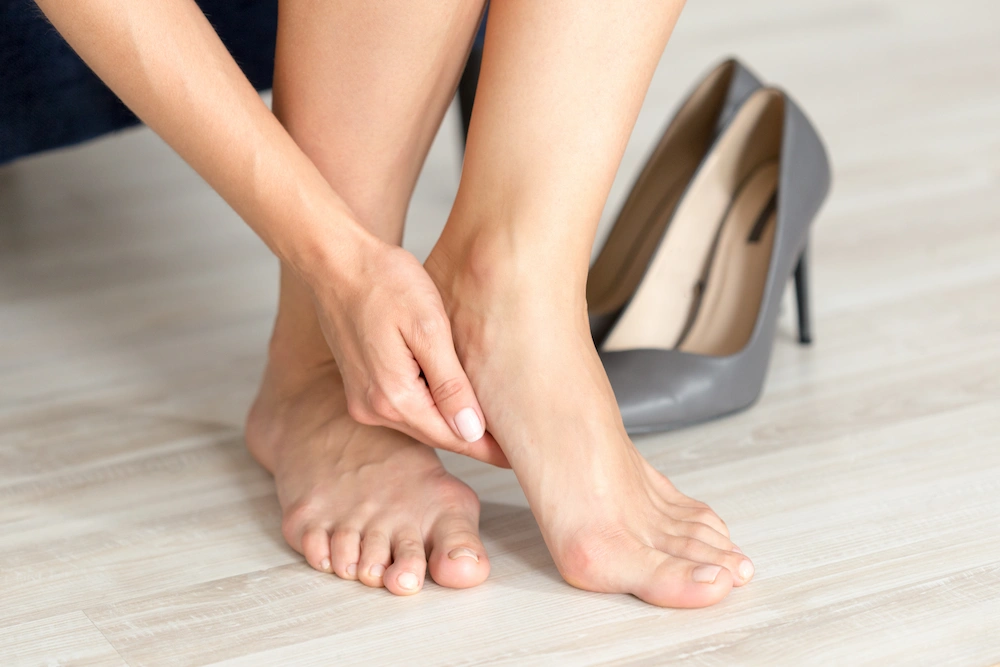
That sharp, stabbing heel pain when you take your first steps out of bed in the morning is the classic sign of plantar fasciitis, and most people treat it entirely at the foot. But the cause often originates higher up, in the pelvis and lower spine, which is why so many people in Southpark deal with heel pain that improves briefly and keeps coming back. At Axiom Chiropractic, we find that addressing the spinal and pelvic contributors is frequently the missing piece in foot pain that won’t fully resolve.
Why That First Step Hurts So Much
The plantar fascia is a thick band of connective tissue that runs along the bottom of your foot, from the heel to the toes. It supports the arch and absorbs the load of every step. Plantar fasciitis is inflammation and microtearing of this tissue, usually where it attaches to the heel bone.
The reason it hurts most with those first morning steps is that the fascia tightens and partially heals overnight while you’re off your feet. When you stand and load it again first thing in the morning, that tightened, healing tissue gets suddenly stretched and stressed, producing the sharp, stabbing pain people describe. After a few minutes of walking, the tissue warms up and loosens, and the pain often eases. Then it tends to return after periods of sitting or at the end of a long day on your feet.
That pattern is the hallmark of plantar fasciitis. But understanding why the fascia became inflamed in the first place is where the spinal connection comes in.
The Kinetic Chain: How the Spine Affects the Foot
Your body is one connected mechanical system, often called the kinetic chain. The foot doesn’t function in isolation. The way force travels from the ground up through your foot, ankle, knee, hip, pelvis, and spine, and back down again, depends on every link in that chain working properly.
When the pelvis is misaligned or the lower spine isn’t functioning correctly, it changes how you walk. The misalignment alters your gait, shifts your weight distribution, and changes the angle at which your foot strikes the ground and bears load. Even subtle changes, repeated thousands of times a day with every step, place abnormal stress on the plantar fascia.
Here’s a common pattern we see. A misalignment in the lumbar spine or sacroiliac joint causes one leg to function as though it’s slightly shorter or to bear weight differently than the other. The body compensates by altering the gait. That altered gait changes the foot mechanics on one or both sides. Over time, the abnormal loading inflames the plantar fascia, and the person develops heel pain, often worse on one side than the other, which is itself a clue that something asymmetrical is happening upstream.
Treating only the foot in this scenario, with stretches, orthotics, or injections, addresses the inflamed tissue but not the reason it’s being abnormally loaded. The relief is often temporary because the gait and weight distribution problem is still there, continuing to stress the fascia.
The Nerve Supply Angle
There’s also a neurological dimension. The nerves that supply the muscles of the foot and lower leg, including the muscles that support the arch and influence how the plantar fascia is loaded, originate in the lower lumbar spine and sacrum, primarily at L4, L5, and S1.
When these spinal levels are misaligned, the nerve supply to the foot and lower leg can be affected. This can alter muscle function and coordination in the foot, change how the arch is supported, and contribute to the abnormal mechanics that stress the plantar fascia. It can also produce a component of the pain that feels like it’s in the foot but is partly originating from nerve irritation higher up.
How We Approach Heel Pain at Axiom
When a Southpark patient comes in with persistent heel pain or plantar fasciitis that hasn’t fully resolved, we assess the whole kinetic chain rather than just the foot.
Full-spine, weight-bearing X-rays show us the position of the lumbar spine and pelvis and reveal any misalignment or asymmetry that could be altering gait and foot loading. We assess the sacroiliac joints specifically, since SI joint dysfunction is one of the most common pelvic contributors to altered lower-body mechanics. Nervoscope instrumentation identifies nerve irritation at the lumbar and sacral levels that supply the foot and lower leg.
We also evaluate gait and posture directly, watching how you stand, how you distribute weight, and how you move, since these reveal the functional consequences of any structural misalignment.
From there, specific Gonstead chiropractic adjustments address the lumbar and pelvic misalignments driving the altered mechanics. When the pelvis and lower spine are properly aligned, gait normalizes, weight distribution evens out, and the abnormal stress on the plantar fascia is reduced, giving the inflamed tissue a chance to actually heal rather than being continually re-irritated.
For patients dealing with foot pain alongside lower back issues, our back pain page covers the lumbar and pelvic contributors, and our extremity pain page explains how spinal problems contribute to symptoms throughout the limbs.
The Role of Local Foot Care Too
Addressing the spinal and pelvic side doesn’t mean ignoring the foot. The best outcomes usually come from treating both. Local measures that support recovery include calf and plantar fascia stretching, which addresses tightness in the tissue and the connected calf muscles, and supportive footwear that doesn’t aggravate the arch.
Some patients benefit from temporary use of supportive inserts while the tissue heals, though we’re cautious about relying on orthotics as a permanent solution, since they support the foot without correcting the upstream mechanics causing the problem. Night splints that keep the fascia gently stretched overnight can reduce that sharp first-step morning pain for some people.
The point is that these local measures work much better when the spinal and pelvic drivers are corrected at the same time. You’re treating the inflamed tissue while also removing the reason it became inflamed.
Frequently Asked Questions
I’ve tried orthotics and stretching without lasting relief. Why would chiropractic be different?
If orthotics and stretching addressed the foot but the heel pain keeps returning, that’s often a sign the cause is upstream. Orthotics support the foot but don’t correct a pelvic or lumbar misalignment that’s altering your gait. Addressing that structural driver is what’s frequently missing from foot-only treatment approaches.
How do I know if my heel pain is connected to my spine?
Some clues point that direction: heel pain that’s worse on one side, heel pain that accompanies low back or hip discomfort, or plantar fasciitis that hasn’t responded to foot-focused treatment. A full assessment is the only way to know for certain whether a spinal or pelvic component is involved, and to what degree.
How long before heel pain improves with care?
It depends on how long the problem has been present and how significant the structural contributors are. Some patients notice changes within a few weeks as gait and loading normalize. Plantar fascia tissue does take time to heal once the abnormal stress is reduced, so we set realistic expectations after assessing your specific situation.
If morning heel pain has been a frustrating, recurring problem, the answer may be higher up than your foot. Call (704) 469-4772 or schedule a consultation at Axiom Chiropractic in Southpark and let’s look at the whole picture, from your spine to your feet.

Axiom Chiropractic & Wellness Center serves Charlotte, NC and surrounding communities with expert Gonstead chiropractic care, advanced red light therapy, functional medicine, and specialized animal chiropractic. Led by Dr. Tyler Hartley and Dr. Megan Hullihen, we help families overcome back pain, neck pain, headaches, sciatica, and digestive issues through precise spinal corrections. Call (704) 469-4772 or schedule online to start your wellness journey today.