
If you’ve been dealing with dizziness, unsteadiness, or a vague off-balance feeling that nobody can quite explain, your neck may be the culprit. The upper cervical spine plays a direct role in your sense of balance and spatial orientation, and when those top vertebrae are misaligned, dizziness is a common and frequently overlooked result. At Axiom Chiropractic in Southpark, we see patients who’ve cycled through ENT visits, blood work, and inner ear testing without answers, only to find the source was a cervical problem all along.
How Your Neck Affects Your Balance
Most people associate balance with the inner ear, and the inner ear is certainly part of the system. But balance is actually maintained by three separate inputs that the brain constantly integrates: the vestibular system in the inner ear, the visual system in your eyes, and the proprioceptive system – the position sensors located throughout your body, with an especially high concentration in the upper cervical spine.
The joints, muscles, and ligaments of the upper neck are densely packed with sensory receptors that tell your brain exactly where your head is positioned relative to your body. This information is critical. Your brain combines it with the inner ear and visual input to produce a unified sense of balance and spatial orientation.
When the upper cervical spine is misaligned, those position sensors send faulty information to the brain. The signal from the neck no longer matches the signals from the inner ear and eyes. The brain receives conflicting information about where your head and body are in space, and the result is dizziness, unsteadiness, or a disoriented feeling. This is called cervicogenic dizziness, meaning dizziness originating from the neck.
What Cervicogenic Dizziness Feels Like
Dizziness from a neck origin has some characteristic features that distinguish it from inner ear causes:
It often accompanies neck pain or stiffness. When dizziness and neck tension show up together, or when the dizziness worsens during periods of neck pain, that’s a strong signal the two are connected.
It’s triggered or worsened by neck movement or positions. Turning the head, looking up, or holding the neck in certain positions can bring on or intensify the dizziness. This is different from the inner ear condition BPPV, which is triggered specifically by head position changes relative to gravity.
It tends to be a vague unsteadiness rather than a spinning sensation. Cervicogenic dizziness is more often described as floating, swaying, disorientation, or a sense of being off-balance, rather than the intense room-spinning vertigo that typically points to an inner ear cause.
It frequently follows neck trauma. A history of whiplash, a head or neck injury, or even a period of significant neck strain often precedes the onset of cervicogenic dizziness. Many patients can trace their symptoms back to a specific neck event.
Inner ear and neurological testing comes back normal. Patients with cervicogenic dizziness have often been thoroughly evaluated for inner ear and neurological causes with no clear findings, because the source isn’t in those systems.
Why the Upper Cervical Spine Matters So Much
The top two vertebrae – the atlas (C1) and axis (C2) – are particularly important for balance. They have the highest concentration of position sensors in the entire spine, and they sit immediately adjacent to the brainstem, where balance information is processed.
The atlas is also unique structurally. It has no disc, moves through a wide range of motion to allow head rotation, and supports the full weight of the head. This combination makes it both mechanically vulnerable to misalignment and neurologically influential when misalignment occurs.
When the atlas or axis shifts out of position, it disrupts the position-sense signals from the upper neck and can affect blood flow and neurological function in the region adjacent to the balance centers of the brainstem. Restoring proper alignment to these segments often produces noticeable improvement in balance and a reduction in dizziness.
How We Assess Dizziness at Axiom
When a Southpark patient comes in with unexplained dizziness, the upper cervical spine is a primary focus of our assessment – though we always take a careful history first to understand the full picture and to identify when a referral for inner ear or neurological evaluation is the more appropriate path.
Full-spine, weight-bearing X-rays with particular attention to the upper cervical region show us the position of the atlas and axis relative to the skull and the rest of the cervical spine. Even small misalignments at this level can have significant neurological effects given the density of position sensors and the proximity to the brainstem.
Nervoscope instrumentation scans for temperature asymmetry at the upper cervical levels, identifying nerve irritation in the region. Palpation assesses the motion and position of the upper cervical segments and the tension in the suboccipital muscles, which are richly supplied with the position sensors involved in balance.
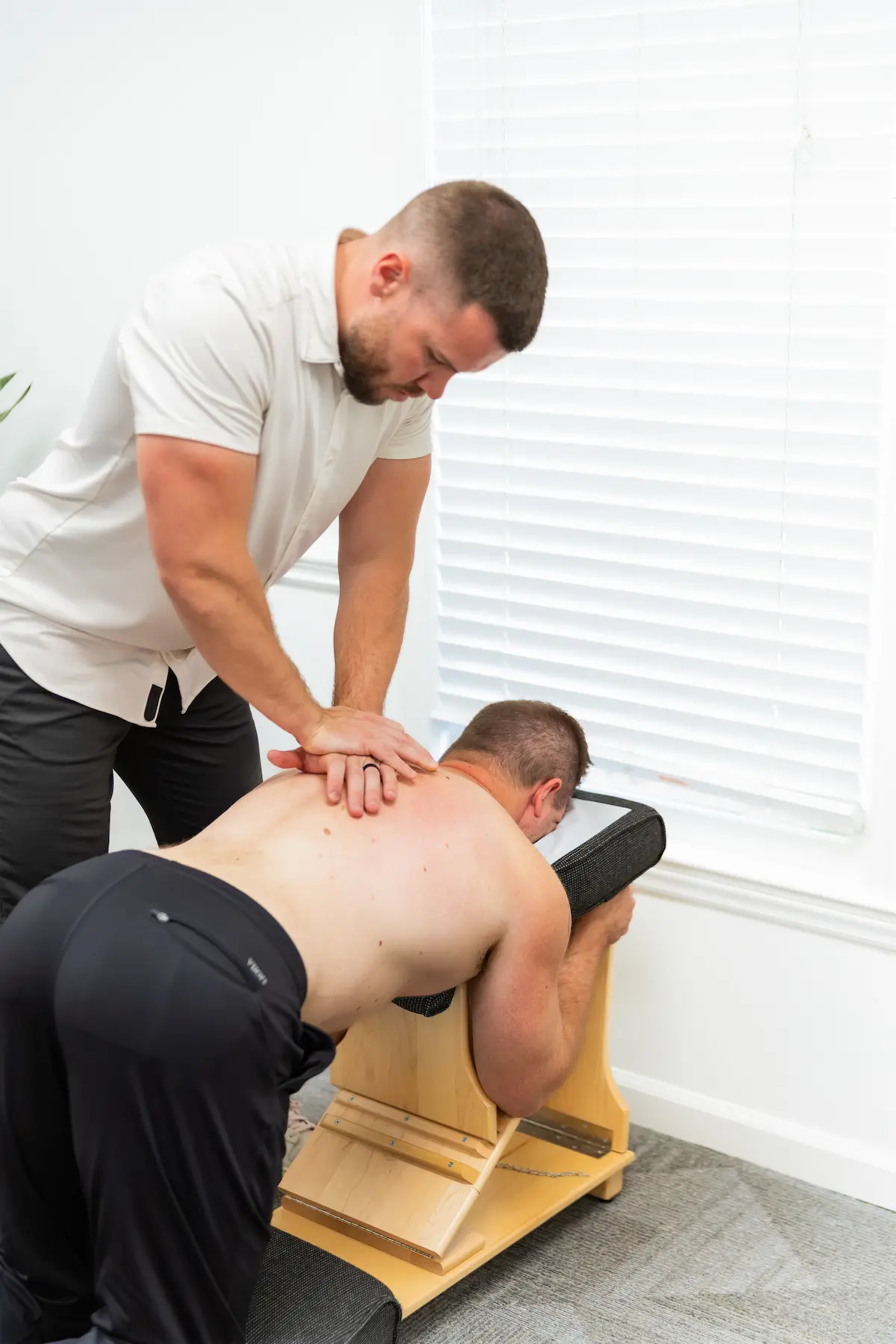
Specific Gonstead chiropractic adjustments to the upper cervical spine are delivered without rotation, using a precise, controlled correction based on the X-ray analysis. Restoring proper position to the atlas and axis allows the position sensors to send accurate information again, which the brain can then integrate correctly with the inner ear and visual input.
Because the assessment involves objective measurement, we can also use our INSiGHT nervous system scan to evaluate overall nervous system function and track changes as care progresses. Our neck pain page covers the cervical mechanisms involved in more detail.
When Dizziness Is Not From the Neck
Being honest matters here. Not all dizziness is cervicogenic, and some causes of dizziness require medical evaluation rather than chiropractic care.
Benign paroxysmal positional vertigo (BPPV), an inner ear condition involving displaced crystals in the semicircular canals, is a common cause of true spinning vertigo and is treated with specific repositioning maneuvers. Meniere’s disease, vestibular neuritis, and other inner ear conditions have their own presentations and treatments. Dizziness can also occasionally signal cardiovascular issues, medication side effects, blood pressure problems, or in rare cases more serious neurological conditions.
Part of our assessment is recognizing when dizziness has features that point away from a cervical origin and toward something that needs medical evaluation. We’re not the right first stop for every dizzy patient, and we’ll say so clearly when a referral is the better path. But for the significant number of patients whose dizziness is cervicogenic and has gone unexplained through inner ear and neurological workups, the cervical spine is often the missing piece.
Frequently Asked Questions
I’ve already seen an ENT and they found nothing. Could it still be my neck?
Yes, and this is actually one of the most common scenarios we see. When inner ear and neurological evaluations come back clear but the dizziness persists, a cervical origin becomes more likely. The neck isn’t usually part of a standard dizziness workup, so it’s frequently the source that nobody checked.
How quickly might dizziness improve with cervical care?
Some patients notice improvement within the first few visits, particularly when the upper cervical misalignment is the primary driver. Others take longer as the nervous system recalibrates to the corrected position-sense information. We track progress objectively and set realistic expectations after the initial assessment.
Is it safe to adjust the upper neck if I’m already dizzy?
Gonstead upper cervical adjustments are delivered without rotation, using a specific, controlled, low-force correction based on X-ray analysis. This approach is both precise and gentle. We assess thoroughly before adjusting and screen for any signs that would make cervical care inappropriate, in which case we refer for medical evaluation instead.
If dizziness has been disrupting your life and nobody has been able to explain it, your neck deserves a look. Call (704) 469-4772 or schedule a consultation at Axiom Chiropractic in Southpark and let’s find out whether the cervical spine is what’s been throwing you off balance.

Axiom Chiropractic & Wellness Center serves Charlotte, NC and surrounding communities with expert Gonstead chiropractic care, advanced red light therapy, functional medicine, and specialized animal chiropractic. Led by Dr. Tyler Hartley and Dr. Megan Hullihen, we help families overcome back pain, neck pain, headaches, sciatica, and digestive issues through precise spinal corrections. Call (704) 469-4772 or schedule online to start your wellness journey today.