
Massage therapy and chiropractic care are often seen as competing choices, but they actually address different parts of the same picture, and for many people, the best results come from using both. Massage works on the soft tissue, relaxing tight muscles and improving circulation, while chiropractic corrects the alignment and function of the joints and spine. At Axiom Chiropractic in Charlotte, we regularly see how these two approaches complement each other, and understanding the difference helps explain why relying on massage alone sometimes isn’t enough.
What Massage Therapy Does
Massage therapy focuses on your muscles and soft tissue. Through various hands-on techniques, a massage therapist works to release muscle tension, break up adhesions, improve blood flow, and promote relaxation. For tight, overworked, or knotted muscles, massage can feel wonderful and provide real relief.
The benefits of massage are genuine. It reduces muscle tension, increases circulation to the tissues, promotes relaxation and lowers stress, and can temporarily ease the discomfort of tight or sore muscles. For general tension, stress relief, and muscular soreness, it’s a valuable tool.
The key thing to understand is that massage works on the muscle. It addresses soft tissue tension, which is often a symptom of a deeper issue, but it doesn’t correct the position or function of the joints and spine.
What Chiropractic Care Does
Chiropractic care focuses on the alignment and function of your spine and joints. When a vertebra is misaligned or a joint isn’t moving properly, it can irritate nearby nerves and disrupt how your body functions, often causing the very muscle tension that massage then tries to relieve.
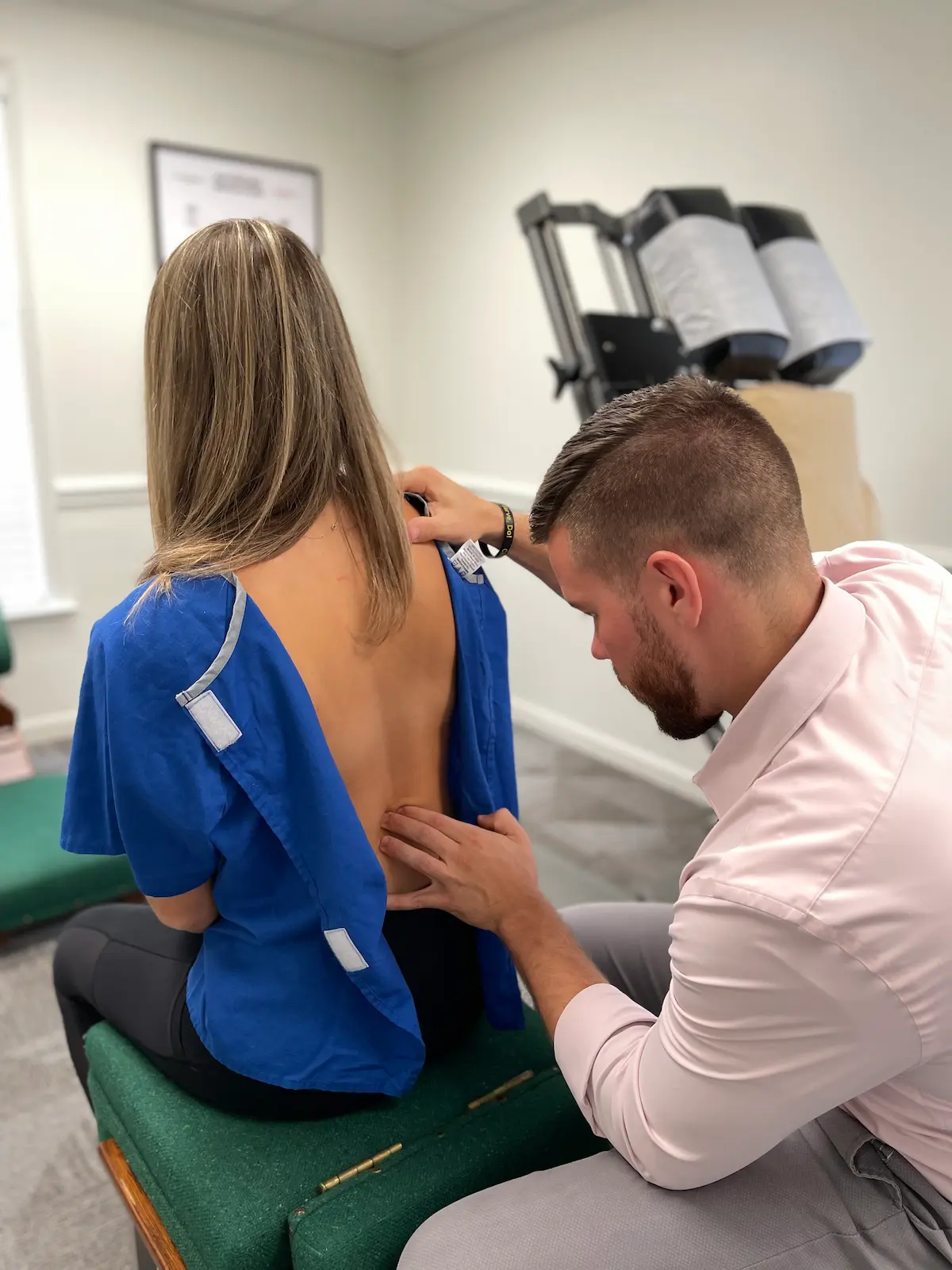
A chiropractic adjustment is a specific, controlled correction that restores proper position and motion to a misaligned or restricted segment. At Axiom, we use the Gonstead method, identifying exactly which segments need correction through full-spine X-rays, instrumentation, and palpation, then delivering a precise adjustment to those specific segments.
Chiropractic addresses the structural and neurological root of a problem. By correcting the misalignment and relieving nerve irritation, it targets the underlying cause rather than the downstream muscle tension.
Why You Might Need Both
Here’s where the relationship between the two becomes clear, and where the case for combining them comes from.
Very often, tight muscles are a symptom of an underlying joint or spinal problem. When a spinal segment is misaligned and irritating a nerve, the muscles that nerve supplies tighten protectively. So you get muscle tension, which massage can relieve temporarily, but the misalignment causing the muscle to tighten is still there. Within a short time, the muscle tightens right back up.
This is why so many people get massage after massage for the same stubborn tension that always returns. The massage addresses the muscle beautifully, but it doesn’t touch the joint dysfunction driving the muscle to contract. This exact pattern is why a persistent knot or chronically tight area survives repeated massage, as we cover in our post on why that knot between your shoulder blades won’t go away.
Combining the two addresses both layers. Chiropractic corrects the misalignment causing the muscle to tighten, removing the root driver. Massage relaxes the muscle tension that has built up, supporting the correction and helping the tissue release. Together, they address both the cause and the symptom, which produces better and longer-lasting results than either alone.
There’s also a practical synergy in timing. Relaxed muscles can make adjustments easier and help them hold, while a properly aligned spine reduces the tension that keeps rebuilding in the muscles. The two reinforce each other.
How They Work Together in Practice
Think of it this way. If a misaligned segment is the reason a muscle keeps knotting, massage alone is like repeatedly loosening a bolt that keeps getting tightened by something else. You get relief each time, but the underlying force keeps undoing your progress.
Chiropractic addresses that underlying force by correcting the misalignment. Once the joint is moving properly and the nerve irritation is relieved, the muscle no longer has a reason to keep tightening. Massage then helps clear out the tension that accumulated, and because the driver has been corrected, the relief actually lasts.
For patients dealing with chronic neck pain and the persistent muscle tension that comes with it, this combination often succeeds where years of massage alone provided only temporary relief. Understanding the difference between muscle-driven and joint-driven tension is central to getting lasting results, which we also explore in our post on the difference between a pinched nerve and a muscle knot.
How We Think About It at Axiom
Our focus at Axiom is identifying the root cause of your problem. The Gonstead assessment tells us whether spinal misalignment and nerve interference are driving your muscle tension and pain, and if so, exactly where.
When we correct those misalignments, the muscle tension driven by the underlying joint dysfunction often resolves on its own. For patients who also carry significant accumulated muscle tension, massage can be a valuable complement, relaxing the soft tissue while our adjustments address the structural cause. We’re glad to see patients use both, because they genuinely work well together.
The important thing is not to rely on massage alone for a problem that’s actually structural. If your muscle tension keeps coming back no matter how many massages you get, that’s a strong sign there’s an underlying joint or spinal issue that needs to be addressed at the source.
Frequently Asked Questions
Should I get a massage before or after an adjustment?
Both can work well, and it often comes down to preference. Some people find that massage before an adjustment relaxes the muscles and helps the adjustment go smoothly. Others prefer massage after, to relax any residual tension. What matters most is that both are being done, since they address different layers of the problem.
If chiropractic fixes the cause, why would I still need massage?
Chiropractic corrects the misalignment driving the muscle tension, and often that tension resolves on its own as a result. But when significant muscle tension has built up over time, massage helps clear it out and speeds the relief. Think of chiropractic as addressing the cause and massage as helping the accumulated symptom release more quickly. They’re complementary, not redundant.
Why does my muscle tension keep coming back after massage?
Usually because the tension is being driven by an underlying joint or spinal misalignment that massage doesn’t correct. When a misaligned segment irritates a nerve, the muscle it supplies tightens protectively. Massage relaxes it temporarily, but the misalignment keeps the muscle tightening back up. Correcting the underlying issue is what stops the cycle.
If you love massage but your tension always comes back, there may be a structural cause that needs addressing too. Call (704) 469-4772 or schedule a consultation at Axiom Chiropractic in Charlotte and let’s find out what’s really driving your muscle tension.
Axiom Chiropractic & Wellness Center serves Charlotte, NC and surrounding communities with expert Gonstead chiropractic care, advanced red light therapy, functional medicine, and specialized animal chiropractic. Led by Dr. Tyler Hartley and Dr. Megan Hullihen, we help families overcome back pain, neck pain, headaches, sciatica, and digestive issues through precise spinal corrections. Call (704) 469-4772 or schedule online to start your wellness journey today.