Shoulder pain, knee pain, and hip pain don’t always start where they hurt. In many cases, the real driver is a spinal misalignment that’s altering how nerve signals reach the joint, how muscles around the joint fire, or how weight is distributed through the body. At Axiom Chiropractic in Southpark, we find spinal contributors to extremity pain in patients regularly – people who’ve treated the shoulder or knee directly for months without lasting improvement, because the source was never properly addressed.
Why Extremity Pain Is Often a Spine Problem
The body is one interconnected mechanical and neurological system. Every joint in your extremities – your shoulders, elbows, wrists, hips, knees, ankles – is controlled by nerves that originate in your spine.
When a vertebra in the cervical spine misaligns, the nerve roots exiting that level can become irritated. Those same nerves supply the muscles, tendons, and joints of the shoulder and arm. The result can be shoulder pain, weakness, tingling into the arm, or limited range of motion – with no structural problem in the shoulder itself.
The same principle applies in the lower body. The lumbar spine and sacrum supply the nerves that control the hip, knee, and ankle. Misalignments in the lower lumbar region can produce hip pain that feels exactly like a hip joint problem. Sacroiliac dysfunction can drive pain into the outer hip and knee. And because the pelvis is the foundation the legs move from, pelvic misalignment can alter gait and load patterns in ways that eventually stress the knee or ankle.
If you’ve been treating your shoulder or knee in isolation, you may be treating the symptom while the cause continues upstream.
The Compensation Pattern: How Spinal Problems Create Joint Pain
Here’s a pattern we see in Southpark patients regularly:
A person develops a low back problem – a lumbar misalignment they may or may not be aware of. To protect the painful area, they subconsciously shift how they walk, stand, and move. This altered movement pattern changes how force is distributed through the hip and knee on one or both sides.
Over months or years, that compensatory loading pattern creates wear and stress in a hip or knee that wouldn’t otherwise be there. The person eventually develops knee pain and seeks treatment for the knee – but the knee is only painful because of what the spine and pelvis did upstream.
Treating only the knee provides temporary relief. The underlying compensation pattern continues. The knee pain returns.
This is one of the most common reasons extremity pain becomes chronic. The source – the spinal misalignment driving the compensation – was never found or corrected.
Nerve Supply: Matching the Joint to the Spinal Level
Understanding which spinal levels supply which joints helps explain why this connection is predictable, not coincidental.
Shoulder and Upper Extremity
The shoulder, arm, and hand receive their nerve supply primarily from the cervical spine (C4 through C8) and the first thoracic vertebra (T1). Misalignments in the lower cervical spine are among the most common findings in patients presenting with shoulder pain, arm weakness, or numbness and tingling into the fingers.
This is especially relevant for Southpark desk workers and anyone who spends significant time looking at screens. Forward head posture – almost universal in office environments – loads the lower cervical spine heavily and accelerates the kind of misalignment that produces shoulder and arm symptoms.
Hip and Upper Leg
The hip joint and upper leg muscles are supplied primarily from the lumbar spine (L1 through L3) and the sacrum. Lumbar misalignments at these levels can produce hip flexor pain, groin pain, outer hip pain, and weakness in the leg – all of which may be mistaken for structural hip problems.
Knee
The knee receives nerve supply from L3, L4, and L5. These lumbar levels are also involved in common disc issues and are heavily affected by sacroiliac joint dysfunction. Knee pain that worsens when the low back is also symptomatic is a strong indicator that a spinal component is driving the knee complaint.
Ankle and Foot
The lower lumbar spine (L4, L5) and sacral nerve roots supply the ankle, foot, and calf. Numbness or tingling in the foot that accompanies ankle pain, or foot pain with no clear local cause, often traces back to the lumbar spine or sacrum.
How Gonstead Chiropractic Addresses Extremity Pain
At Axiom, we use the full five-criteria Gonstead analysis to find exactly which spinal levels are involved – not just the levels closest to where it hurts.
Full-spine X-rays show us the structural position of the spine from top to bottom. A patient who comes in with shoulder pain gets a full-spine assessment, not just a cervical X-ray, because we know the whole spine’s structural picture affects how individual segments compensate. Instrumentation scans (using the Nervoscope) identify areas of nerve irritation along the entire spine with objective temperature readings – not guesswork.
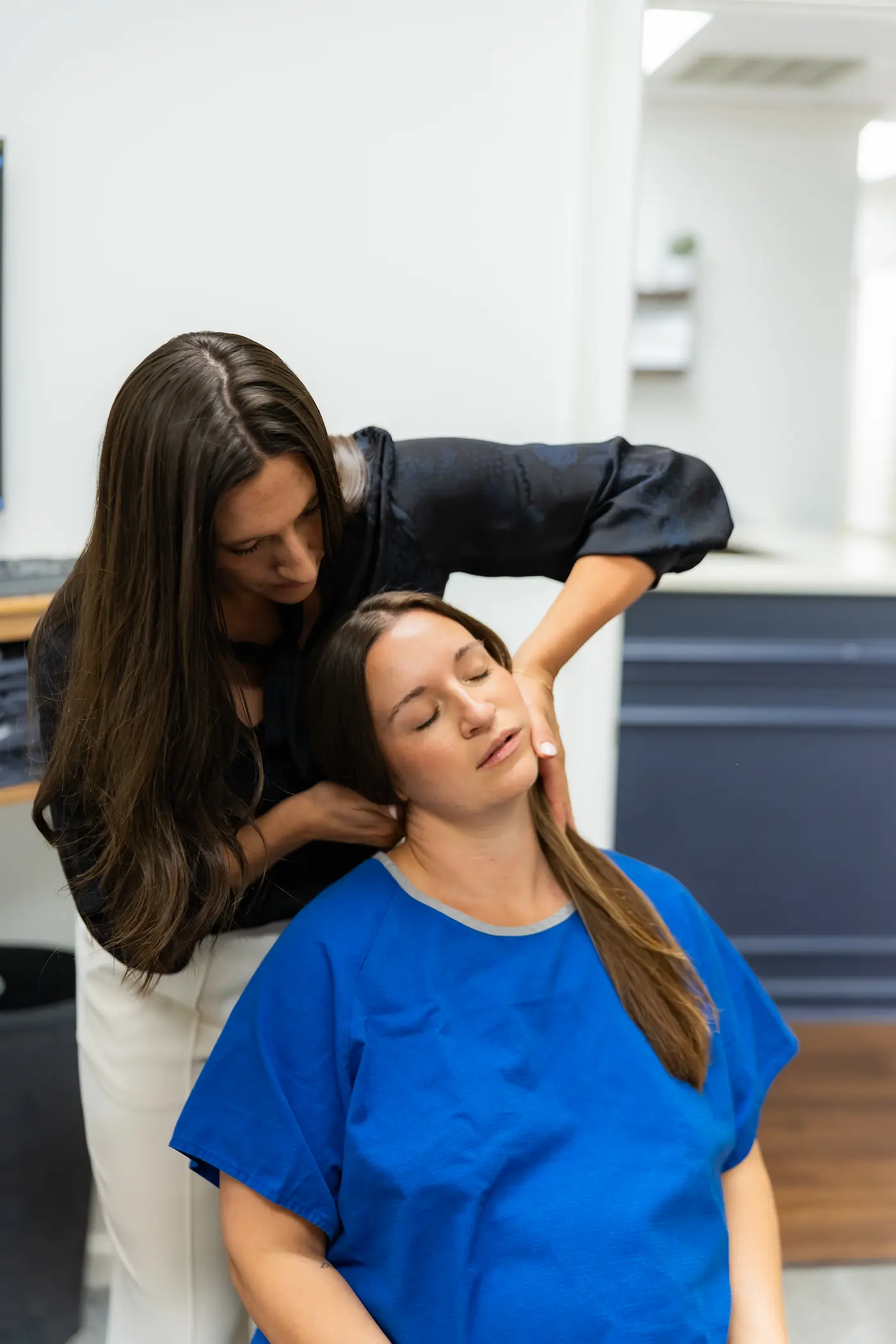
When we identify a cervical misalignment driving shoulder symptoms, the Gonstead adjustment at that level uses a precise line of drive and contact point. No rotation of the neck. No generalized manipulation. A specific correction at the specific segment that’s causing the problem.
The same specificity applies to lumbar and sacral adjustments for hip and knee complaints. The adjustment is designed to restore the vertebra’s normal position and motion – relieving the irritation on the nerve roots that supply the joint that’s hurting.
You can read more about how this process works on our Gonstead chiropractic service page.

When the Extremity Itself Is Also the Problem
It’s worth being clear: not every case of shoulder pain is a cervical spine issue, and not every knee problem traces to the lumbar spine. Some joints have their own local problems – a rotator cuff tear, an ACL injury, a meniscal problem – that require orthopedic evaluation and sometimes surgical intervention.
Part of the Gonstead assessment process is determining whether the joint complaint has a spinal component, a local joint component, or both. In our experience, spinal involvement is present more often than patients and even many practitioners expect – but we’re honest when local joint pathology is the primary driver and a referral is more appropriate.
Many patients with confirmed local joint problems also have a spinal component that was never identified. In those cases, addressing both produces better outcomes than treating only the joint.
The Southpark Patient Who’s “Tried Everything” for Shoulder or Knee Pain
We hear this regularly in our practice. A patient has been to physical therapy, seen an orthopedist, maybe had a cortisone injection or two. The shoulder or knee improved temporarily but keeps coming back. Nobody ever looked at the spine in the context of that joint complaint.
Sometimes the missing piece is straightforward: a cervical misalignment that’s been driving chronic shoulder irritation, or a lumbar/pelvic issue that’s been loading the knee abnormally for years. When that’s corrected with specific Gonstead adjustments, the joint finally has a chance to heal – because the underlying neuromechanical driver has been removed.
We’ve worked with Southpark patients who’d been managing shoulder or knee pain for years and found significant, lasting improvement once the spinal component was identified and addressed. Not every case resolves this way, but enough do that if you haven’t had your spine thoroughly evaluated in the context of your extremity pain, it’s worth doing.
For patients dealing with extremity pain alongside back or neck issues, our back pain and neck pain condition pages have more detail on how we approach the spinal side of the picture.
Frequently Asked Questions
Can chiropractic help with shoulder impingement?
It depends on what’s driving the impingement. If cervical misalignment is affecting the nerve supply to the muscles that control shoulder positioning (particularly the rotator cuff), correcting the cervical spine can improve muscle function and reduce the impingement pattern. If there’s also local structural pathology in the shoulder, we’ll identify that and recommend appropriate co-management.
My MRI shows a knee problem – does the spine still matter?
Possibly, yes. Structural findings on MRI don’t tell you why that structure was stressed to the point of showing damage. If a pelvic or lumbar misalignment has been altering your gait and loading your knee abnormally, that misalignment is still worth correcting even if there’s also local knee pathology. Treating both gives you a better shot at lasting improvement.
Do you treat the extremity directly or only the spine?
Both, when indicated. Gonstead-trained chiropractors assess and adjust extremity joints directly when there’s local joint misalignment. At Axiom, our assessment determines where the adjustment needs to happen – spine, extremity, or both – based on objective findings. We don’t assume it’s always the spine, and we don’t ignore the spine because the patient pointed to their knee.
If you’ve been dealing with shoulder, knee, hip, or other joint pain that keeps coming back despite treatment, your spine may be part of the story nobody’s told you yet. Call (704) 469-4772 or book a consultation at Axiom Chiropractic in Southpark and let’s find out what’s actually driving your pain.