
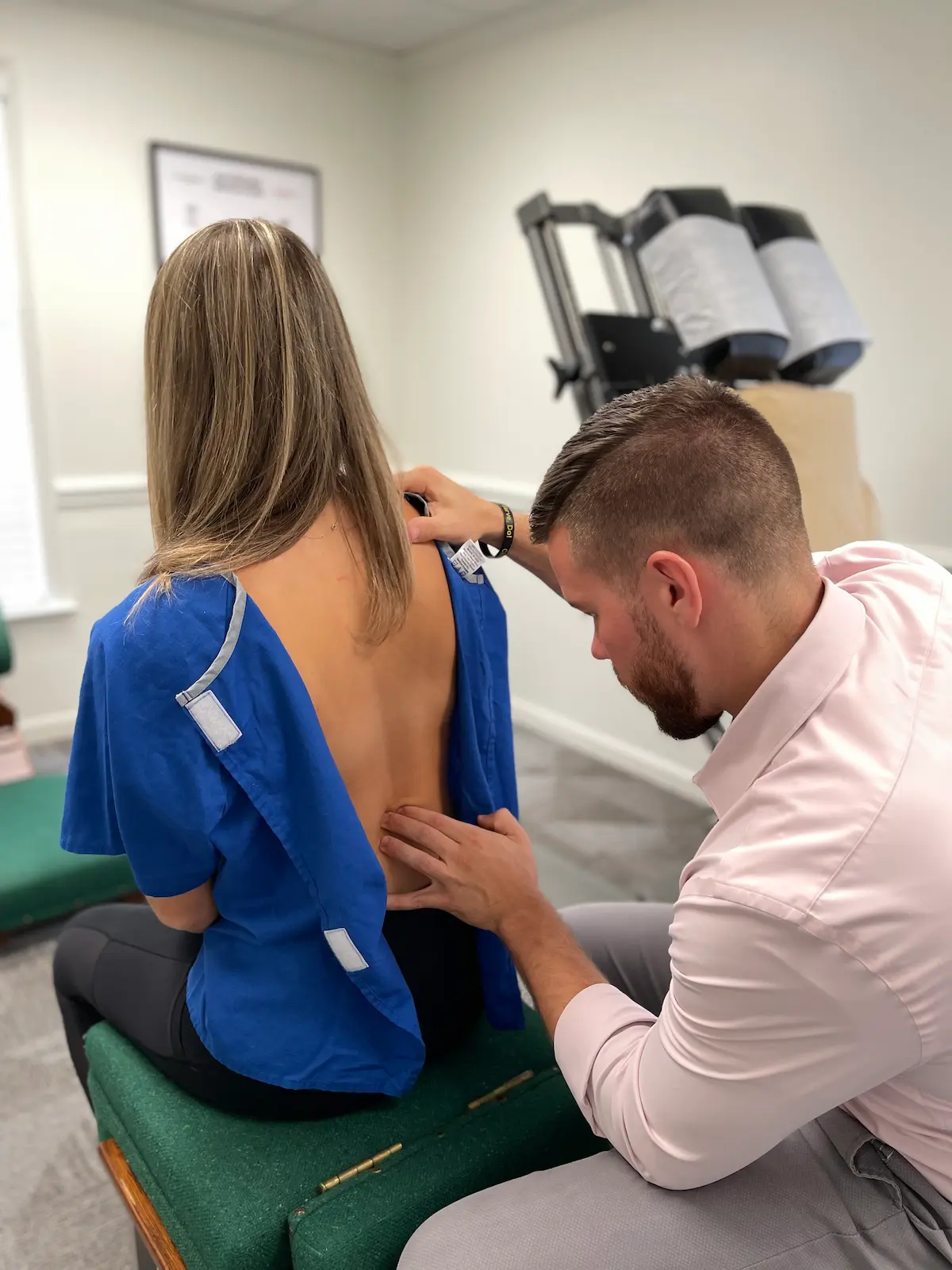
Spinal decompression and chiropractic adjustment are often confused, but they’re distinct approaches that address spinal problems in different ways. Spinal decompression uses gentle mechanical traction to relieve pressure on discs and nerves, while a chiropractic adjustment is a specific, controlled correction that restores proper alignment and motion to a misaligned spinal segment. At Axiom Chiropractic in Charlotte, we use the Gonstead adjustment as our foundation, and understanding how it differs from decompression helps clarify which approach fits which problem.
What a Chiropractic Adjustment Does
A chiropractic adjustment addresses the position and motion of your spinal segments. When a vertebra is misaligned or restricted, it can irritate the nearby nerves, disrupt normal spinal mechanics, and place uneven stress on the discs and joints. The adjustment corrects this by delivering a specific, controlled force to the affected segment, restoring its proper position and motion.
At Axiom, we use the Gonstead method, which is built around precision. Before adjusting, we identify exactly which segment is misaligned and in which direction, using full-spine weight-bearing X-rays, Nervoscope instrumentation, and palpation. The adjustment is then delivered to that specific segment with a specific line of drive and contact point, no twisting, no general manipulation of the whole spine.
The adjustment works on the root structural and neurological problem, the misalignment itself, and restoring proper joint function is what relieves the associated nerve irritation and allows healing to progress.
What Spinal Decompression Does
Spinal decompression is a form of mechanical traction, typically delivered through a specialized table, that gently stretches and lengthens the spine to reduce pressure within the discs. The idea is that by creating space between the vertebrae and reducing intradiscal pressure, decompression can help relieve compression on discs and nerve roots.
The reduced pressure is thought to help draw bulging or herniated disc material slightly inward, improve fluid and nutrient exchange within the disc, and take pressure off compressed nerves. It’s a slower, more passive process than an adjustment, working gradually over a series of sessions rather than through a single specific correction.
Decompression is used most often for disc-related problems, herniated or bulging discs, degenerative disc disease, and certain cases of nerve compression where relieving disc pressure is the primary goal.
The Key Differences
Here’s how the two approaches differ in practice.
Mechanism
An adjustment is a specific, targeted correction to restore alignment and motion to a segment. Decompression is a gradual mechanical stretch to reduce pressure within the discs. One repositions and restores motion, the other creates space and relieves pressure.
Precision
A Gonstead adjustment is directed at a specific, identified segment based on objective findings. Decompression applies traction more broadly across a region of the spine rather than targeting one precise vertebra.
Speed and Delivery
An adjustment is delivered in a quick, controlled moment, though it’s part of an ongoing care plan. Decompression is a slower, passive process, typically involving the patient lying on a traction table for an extended session, repeated over multiple visits.
Primary Focus
Adjustments address the broad range of problems stemming from spinal misalignment and nerve interference. Decompression is more specifically focused on relieving disc pressure and the nerve compression that results from it.
Which Approach Fits Which Problem?
The two aren’t mutually exclusive, and neither is universally better, they suit different situations.
A chiropractic adjustment is well-suited when the problem involves spinal misalignment, restricted joint motion, and the nerve interference that results, which covers a wide range of issues from back and neck pain to sciatica, headaches, and beyond. The Gonstead adjustment addresses the structural root of these problems directly.
Spinal decompression tends to be considered primarily for disc-specific problems where the main goal is relieving pressure within a herniated or degenerating disc. For certain disc presentations, the gentle traction approach can be a useful tool.
In many disc cases, correcting the underlying misalignment matters most. Here’s an important point from our perspective at Axiom: a disc doesn’t herniate or degenerate randomly. It’s usually under uneven pressure because the spinal segments around it are misaligned. Decompression can relieve the disc pressure, but if the underlying misalignment driving that uneven pressure isn’t corrected, the disc remains vulnerable. This is why we focus on identifying and correcting the structural cause with specific adjustments rather than only relieving the pressure the misalignment created.
For patients dealing with disc pain, our approach is to address why the disc is under abnormal stress in the first place. Our post on why herniated discs aren’t getting better explains this root-cause thinking in more detail.
How We Approach Disc Problems at Axiom
When a Charlotte patient comes in with a disc-related problem, our Gonstead assessment identifies the specific spinal misalignments creating the uneven disc pressure. Full-spine weight-bearing X-rays show us disc space, vertebral position, and how the whole spine is loaded. Instrumentation identifies where nerve irritation is present.
Specific Gonstead adjustments then correct the misaligned segments, taking the abnormal, uneven pressure off the disc so it can heal in a properly aligned environment. Because the Gonstead adjustment is delivered without rotation and with precise control, it’s an appropriate approach for disc cases where general twisting manipulation would be a concern.
The goal is always to address the structural cause, not just the symptom. Relieving disc pressure without correcting the misalignment that created it tends to produce temporary relief. Correcting the alignment gives the disc a genuine chance to recover.
Frequently Asked Questions
Is spinal decompression the same as getting adjusted?
No. They’re different approaches. Decompression uses gradual mechanical traction to reduce pressure within the discs, while an adjustment is a specific, controlled correction to restore alignment and motion to a misaligned segment. They work through different mechanisms and are delivered very differently.
Which is better for a herniated disc?
It depends on the specific case, but our perspective is that correcting the underlying misalignment causing the uneven disc pressure is what matters most for lasting results. Decompression can relieve disc pressure, but if the structural cause isn’t addressed, the disc stays vulnerable. The Gonstead adjustment focuses on correcting that root cause. A proper assessment determines the right approach for your specific disc problem.
Does a chiropractic adjustment hurt a herniated disc?
A general manipulation involving twisting can be a concern with an active disc herniation. The Gonstead adjustment, however, is delivered without rotation, using a specific, controlled correction based on X-ray analysis. This is one of the reasons we use Gonstead for disc cases, it allows precise correction without the rotational forces that could aggravate a disc.
If you’re dealing with a disc problem and trying to understand your options, the most useful first step is identifying what’s actually driving it. Call (704) 469-4772 or schedule a consultation at Axiom Chiropractic in Charlotte and let’s look at what your spine needs.
Axiom Chiropractic & Wellness Center serves Charlotte, NC and surrounding communities with expert Gonstead chiropractic care, advanced red light therapy, functional medicine, and specialized animal chiropractic. Led by Dr. Tyler Hartley and Dr. Megan Hullihen, we help families overcome back pain, neck pain, headaches, sciatica, and digestive issues through precise spinal corrections. Call (704) 469-4772 or schedule online to start your wellness journey today.