
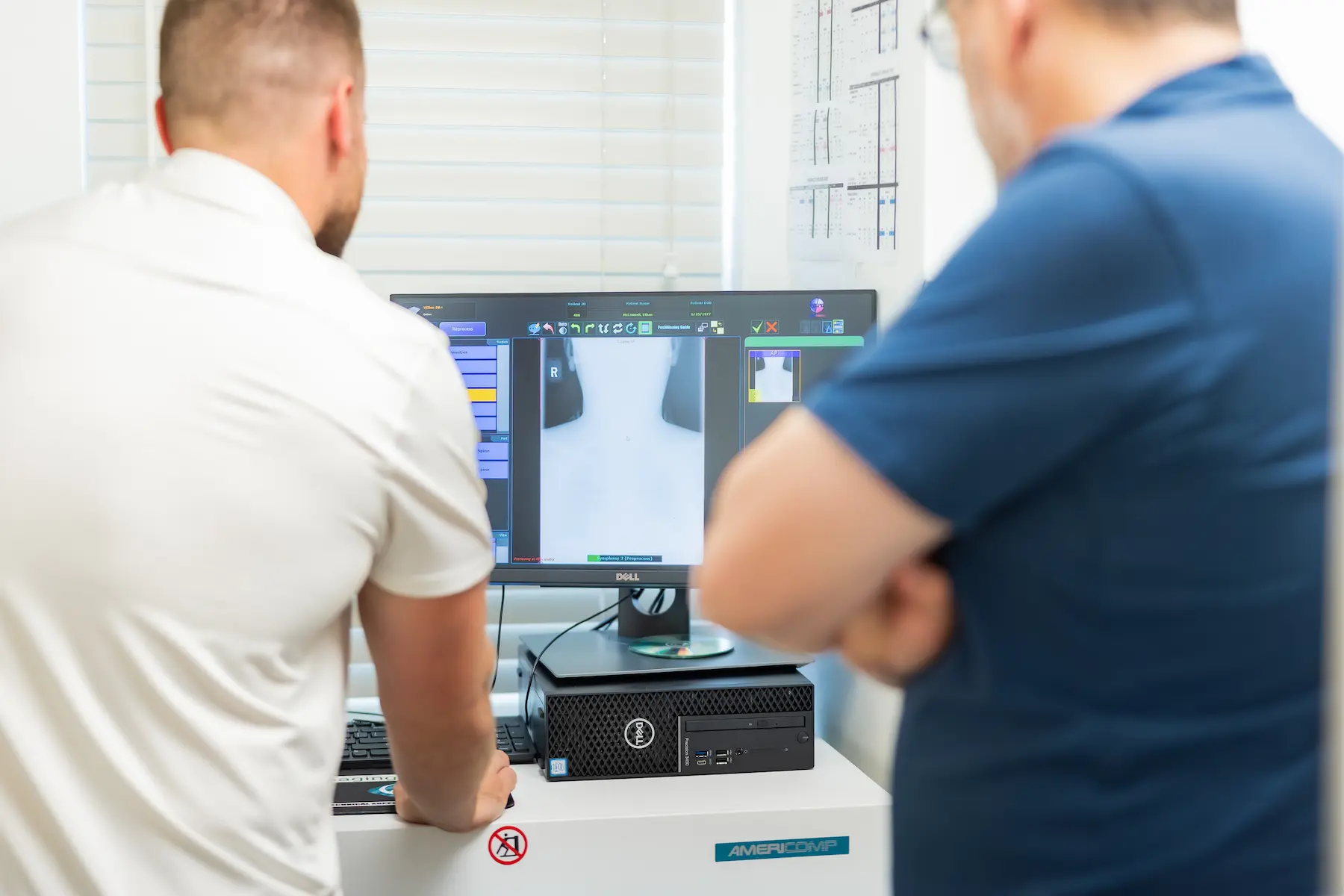
The INSiGHT scan is a non-invasive nervous system assessment that measures how well your spine and nervous system are functioning – not just where you hurt. At Axiom Chiropractic in Southpark, we use INSiGHT scanning as part of every new patient’s initial exam because it gives us objective data about nervous system stress that no amount of physical examination alone can provide. It’s one of the clearest illustrations of why our assessment process is different from most chiropractic practices.
What the INSiGHT Scan Actually Measures
The INSiGHT system combines three separate neurological assessments into a single exam. Each one measures a different dimension of how your nervous system is performing.
Surface EMG (sEMG) – Muscle Tension Along the Spine
Surface electromyography measures the electrical activity of the muscles running along either side of your spine. These muscles are controlled directly by the nervous system, and when spinal nerves are under stress – from misalignment, subluxation, or chronic tension patterns – the muscles they supply show abnormal electrical activity.
The sEMG reading produces a visual graph showing which spinal levels have elevated or asymmetrical muscle activity. Healthy nerve supply produces balanced, appropriate muscle tone on both sides. Areas where the nervous system is under stress show up as spikes, imbalances, or suppressed activity that don’t match the surrounding spinal levels.
This matters because muscle tension in the back is often invisible to the patient until it becomes symptomatic. The sEMG picks up dysfunction before it becomes pain – and it confirms findings at levels that may not be the patient’s primary complaint but are contributing to their overall nervous system load.
Thermal Scan – Autonomic Nervous System Function
The thermal component of the INSiGHT scan measures temperature patterns along both sides of the spine. This is directly related to autonomic nervous system function – specifically the sympathetic nerve fibers that regulate blood flow and temperature in the skin and tissues adjacent to each spinal level.
When a spinal segment is misaligned and irritating the sympathetic nerve fibers in that region, it creates a detectable temperature difference between the left and right sides of the spine at that level. A balanced, healthy nervous system produces symmetrical temperature readings. Asymmetry signals autonomic dysfunction at that spinal level.
This is a similar principle to the Nervoscope instrumentation used during Gonstead analysis, but the INSiGHT thermal scan provides a full-spine map of autonomic nervous system stress in a single pass – giving us an overview picture that guides where to look more closely during palpation and X-ray analysis.
Heart Rate Variability (HRV) – Overall Nervous System Adaptability
Heart rate variability measures the variation in time between consecutive heartbeats. This might sound like a cardiovascular measurement, but it’s actually one of the most sensitive indicators of overall nervous system health and adaptability available without invasive testing.
A healthy nervous system shifts fluidly between sympathetic and parasympathetic states in response to changing demands – activity, rest, stress, recovery. This flexibility shows up as natural variability in the timing between heartbeats. A nervous system that is chronically stressed, stuck in sympathetic dominance, or struggling to regulate produces lower HRV – the heart rate becomes more rigid and less responsive.
HRV gives us a window into the patient’s overall nervous system reserve. Patients with very low HRV are often dealing with significant systemic stress – chronic pain, poor sleep, high anxiety, or long-standing spinal dysfunction that has taxed the autonomic nervous system over time. As care progresses and the nervous system recovers, HRV typically improves – providing objective confirmation that the changes we’re making are having a real systemic effect, not just a local one.
Why Objective Measurement Changes Everything
Most chiropractic practices rely on two sources of information to guide care: what the patient reports feeling, and what the practitioner finds on manual examination. Both of these are valuable – but both are also subjective. Patient pain reports are influenced by sleep, stress, mood, and expectations. Palpation findings reflect the practitioner’s experience and interpretation.
INSiGHT scanning adds a layer of objective neurological data that neither of those sources can provide. The electrical activity of muscles along the spine, the symmetry of autonomic temperature patterns, and the adaptability of the heart rate variability response are all physiological measurements – not interpretations.
This objectivity serves patients in two important ways.
First, it reveals nervous system dysfunction that the patient may not be experiencing as pain yet. Many patients with significant sEMG and thermal findings at multiple spinal levels come in describing only localized symptoms – because the nervous system has compensated well enough to keep symptoms from fully surfacing. Catching those patterns early means we can address them before they become the patient’s next major complaint.
Second, it creates a baseline that makes progress measurable. When we re-scan at regular intervals throughout a care plan, we’re comparing objective neurological data – not just asking “how do you feel?” Patients can see their nervous system stress patterns changing on the scan printout, which reinforces that structural correction is producing real neurological change, not just temporary symptom relief.
What the Scan Looks Like in Practice
The INSiGHT assessment is quick, comfortable, and entirely non-invasive. No needles, no electrical stimulation, no discomfort of any kind.
For the sEMG and thermal portions, a sensor is guided slowly along each side of the spine from neck to sacrum. The patient sits comfortably or lies face-down. The whole scan takes a few minutes. Results display immediately as a color-coded graph showing the pattern of neurological stress across all spinal levels.
The HRV assessment involves a brief period of quiet measurement – often using fingertip sensors – while the patient sits still. This typically takes under five minutes.
Once all three components are complete, we have a full-spine neurological picture to correlate with X-ray findings, Nervoscope instrumentation, and palpation. The combination of these objective tools is what makes Gonstead chiropractic at Axiom genuinely data-driven rather than assessment-by-feel.
How INSiGHT Findings Guide the Care Plan
The scan findings directly influence how we structure a care plan for each patient. Patients with widespread sEMG and thermal findings across multiple spinal levels typically need a longer initial correction phase than patients with isolated findings at one or two levels. Patients with very low HRV may need more frequent early visits to begin shifting the overall nervous system tone before the structural corrections start to hold reliably.
We also use re-scans at scheduled intervals – typically at the 4 to 6 week mark and again at 12 weeks – to objectively track how the nervous system is responding. These progress scans are one of the most motivating parts of the care process for patients. Seeing color-coded nervous system stress decrease on a graph, level by level, makes the progress tangible in a way that “I feel a bit better” doesn’t fully capture.
For patients who aren’t improving as expected, the re-scan data helps identify whether specific levels are responding while others aren’t – which guides adjustments to the care plan rather than just continuing the same approach and hoping for different results.
Who Benefits Most From This Assessment
Every new patient at our Southpark practice goes through the INSiGHT scan as part of their initial exam. But certain patient presentations make the neurological data particularly valuable.
Patients with symptoms that don’t map cleanly to a single spinal level – widespread pain, systemic symptoms like fatigue and poor sleep, or conditions that seem unrelated to the spine like digestive irregularity or chronic headaches – benefit enormously from seeing the full nervous system picture. The scan often reveals patterns that explain why symptoms are manifesting where and how they are.
Patients who’ve had chiropractic care elsewhere without lasting results are another group where the INSiGHT data is particularly clarifying. In many cases, these patients have significant nervous system stress at spinal levels that weren’t identified or addressed in previous care – because those practices weren’t using objective neurological assessment to guide their approach.
And pediatric patients – children and infants who can’t fully articulate what they’re experiencing – benefit from having neurological function assessed objectively rather than relying solely on what parents report. The scan can reveal nervous system stress in a child whose presenting complaint doesn’t obviously suggest spinal involvement.
Frequently Asked Questions
Is the scan safe for children and pregnant women?
Yes. The INSiGHT assessment uses no radiation, no electrical current through the body, and no invasive contact. It’s completely safe for all ages and for pregnant patients at any stage of pregnancy. We scan pediatric patients and prenatal patients routinely.
Can I see my scan results?
Absolutely – and you will. Reviewing scan findings with patients is a standard part of the initial report of findings at Axiom. You’ll see your full neurological picture, understand what the color-coded patterns mean, and have every finding explained before any care recommendation is made. Our goal is that you leave the first appointment understanding your nervous system better than you ever have before.
Do other chiropractors in Southpark use this technology?
Some do, but it’s far from universal. Many practices rely primarily on patient history and manual examination. The combination of INSiGHT scanning, Nervoscope instrumentation, and full-spine weight-bearing X-rays that we use at Axiom represents a more complete objective assessment than most practices offer – and it’s a meaningful reason why our findings are more specific and our outcomes more consistent.
To learn more about how this fits into the full new patient process, visit our about page or read more about the complete Gonstead assessment process on our Gonstead chiropractic service page. Ready to see what your nervous system is doing? Call (704) 469-4772 or schedule your consultation at Axiom Chiropractic in Southpark.

Axiom Chiropractic & Wellness Center serves Charlotte, NC and surrounding communities with expert Gonstead chiropractic care, advanced red light therapy, functional medicine, and specialized animal chiropractic. Led by Dr. Tyler Hartley and Dr. Megan Hullihen, we help families overcome back pain, neck pain, headaches, sciatica, and digestive issues through precise spinal corrections. Call (704) 469-4772 or schedule online to start your wellness journey today.