
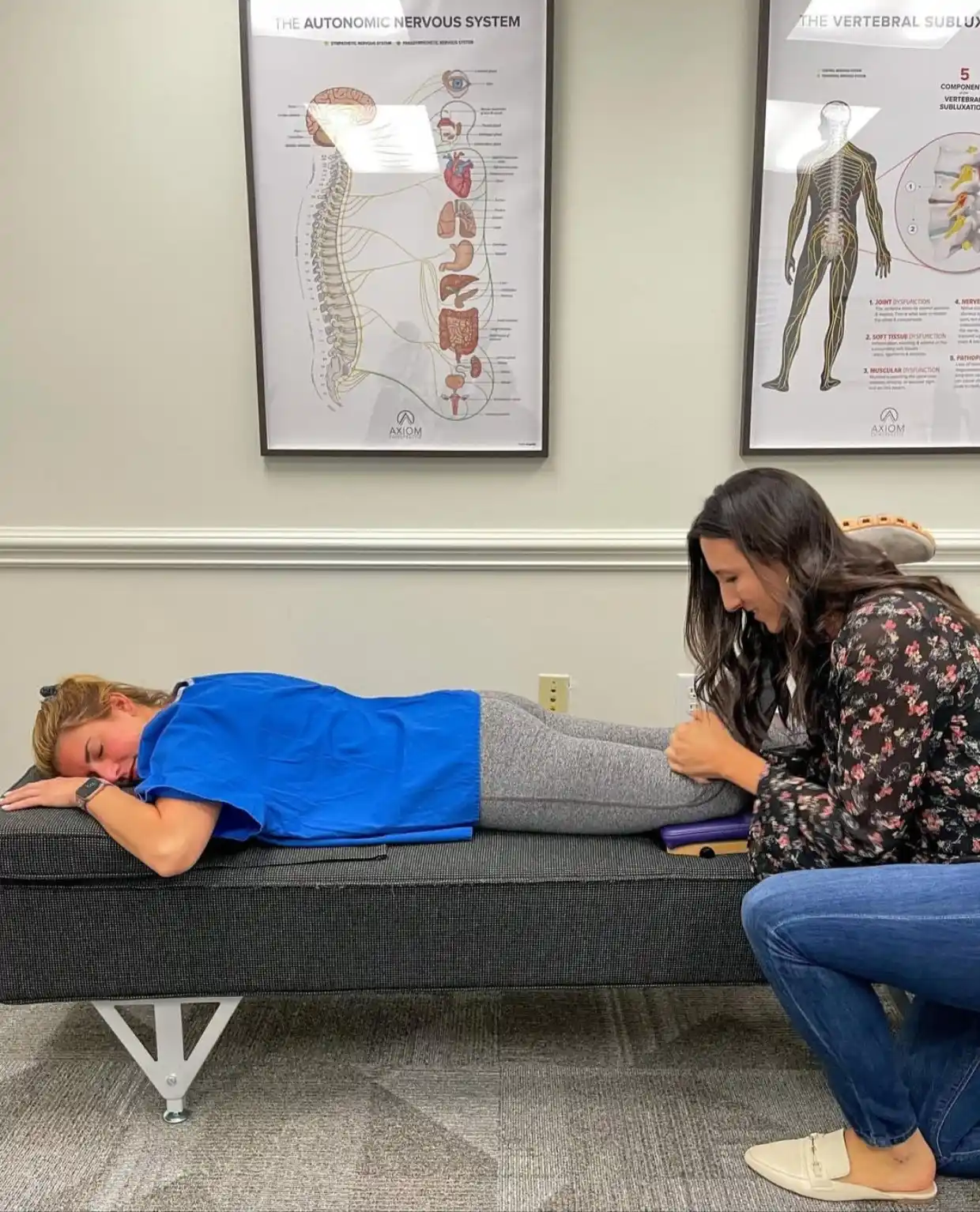
Poor sleep and spinal problems are connected more directly than most people realize – and improving sleep quality is one of the most consistently reported benefits patients notice after starting chiropractic care. At Axiom Chiropractic in Southpark, we regularly hear from patients who came in for back pain or neck pain and found, within a few weeks, that they were sleeping longer and waking up less. The reason isn’t coincidental. Your nervous system governs sleep, and your spine governs your nervous system.
Why Spinal Problems Disrupt Sleep
Sleep isn’t just rest. It’s an active neurological process managed by your autonomic nervous system – specifically the balance between your sympathetic (alerting) and parasympathetic (calming) branches. When that balance is disrupted, sleep suffers in predictable ways: difficulty falling asleep, frequent waking, shallow sleep cycles, and waking up feeling unrefreshed despite adequate hours in bed.
Spinal misalignments contribute to this disruption through two main pathways.
Nervous System Overactivation
The spinal cord and the nerve roots that exit the spine are part of the central and peripheral nervous system. When vertebrae are misaligned, they create mechanical irritation at those nerve roots – a low-level stress signal that the nervous system registers and responds to.
That irritation activates the sympathetic nervous system. The body interprets mechanical stress at the spine the same way it interprets any other stressor – as a threat that needs managing. Sympathetic activation means elevated cortisol, increased alertness, muscle tension, and reduced capacity for the parasympathetic shift that sleep requires.
This is why so many patients with chronic spinal problems describe themselves as “can’t turn my brain off” sleepers. The nervous system is genuinely more activated than it should be – and not because of anxiety or stress alone. There’s a physical driver in the spine contributing to that state.
Pain and Physical Discomfort
This pathway is more obvious but worth stating clearly. Back pain, neck pain, and hip pain are among the most common reasons people wake during the night or struggle to find a comfortable sleep position. Spinal misalignments that create joint irritation, muscle tension, or nerve compression don’t take a break when you lie down.
In fact, certain spinal problems feel worse in specific sleep positions. Cervical misalignments often produce more symptoms when lying on one side. Lumbar misalignments can make lying flat painful, forcing patients into compensatory positions that don’t allow full muscle relaxation. Neither scenario supports quality sleep.
When those misalignments are corrected, the mechanical source of the pain is removed. Patients can find comfortable positions more easily, the pain that was waking them isn’t there anymore, and the nervous system stress driving the sympathetic overactivation decreases.
What Happens to Sleep as the Spine Improves
The pattern we see in our Southpark practice follows a fairly consistent arc. Early in a care plan, patients often report that they’re sleeping more deeply – the quality changes before the total hours necessarily do. They describe feeling like they’re actually going through full sleep cycles again rather than hovering in light sleep.
As structural correction progresses over weeks of care, more patients report falling asleep more easily, waking less during the night, and waking in the morning feeling genuinely rested. Some patients who’ve relied on sleep aids for years find they need them less.
We track this through objective re-examinations – instrumentation scans, palpation findings, and direct patient reporting at regular intervals. Sleep improvement shows up in patient reports consistently enough that we’ve come to expect it as a secondary benefit of successful spinal correction, not a surprise.
The Role of the Upper Cervical Spine
The upper cervical spine – specifically the atlas (C1) and axis (C2) – deserves special mention in the context of sleep. This region is uniquely dense with neurological structures. The brainstem, which regulates autonomic function including the sleep-wake cycle, sits directly adjacent to these vertebrae.
Misalignment in the upper cervical spine can directly influence brainstem function, autonomic regulation, and the body’s capacity to shift into the parasympathetic state needed for sleep. It can also affect cerebral spinal fluid flow and blood flow to the brain – both of which influence neurological function during sleep.
Upper cervical findings are among the most common in our patient assessments, partly because of how much load the neck carries from forward head posture – nearly universal in adults who use screens and sit for work. Correcting upper cervical misalignment through precise Gonstead chiropractic adjustments is one of the most reliable ways we see nervous system tone reduce and sleep quality improve.
Sleep Positions and Spinal Health
A question we get often: does sleep position matter when you’re under chiropractic care? Yes, and it’s worth understanding why.
Side sleeping is generally the most spine-friendly position for most people – it maintains natural lumbar curvature and takes pressure off the discs. A pillow between the knees helps keep the pelvis level. The pillow under the head should support the cervical spine in neutral alignment, not pushing the head up too high or letting it sag too low.
Back sleeping works well for some patients, particularly those with lumbar issues. A pillow under the knees reduces lumbar extension and takes load off the lower back. The challenge is that back sleeping can worsen upper cervical symptoms if the pillow is too high or too thick.
Stomach sleeping is consistently the most problematic position for the spine. It forces the cervical spine into sustained rotation for hours, loads the lumbar spine into extension, and creates asymmetrical muscle tension throughout the back. For patients actively trying to correct cervical or lumbar misalignments, stomach sleeping works against every adjustment we make. If you’re a stomach sleeper, transitioning to side sleeping is worth the short-term adjustment period.
We discuss sleep position specifically with patients whose adjustments aren’t holding as well as expected – because hours spent in a poor sleep position can undo structural progress made in the office.
When Poor Sleep Is Also a Biochemical Problem
Spinal misalignment is one driver of poor sleep. But it’s rarely the only one, and honest assessment requires acknowledging that.
Cortisol dysregulation – where cortisol levels are elevated at night instead of declining as they should – is one of the most common biochemical drivers of insomnia and non-restorative sleep. This can stem from chronic stress, poor blood sugar regulation, thyroid dysfunction, or adrenal fatigue patterns that develop over time.
Low magnesium is another common contributor. Magnesium plays a direct role in nervous system calming and muscle relaxation – deficiency produces restlessness, muscle cramps during sleep, and difficulty reaching deep sleep stages.
This is where our functional medicine blood work service becomes relevant for sleep patients. If spinal correction improves but doesn’t fully resolve sleep issues, looking at cortisol patterns, blood sugar stability, thyroid function, and magnesium status often reveals the remaining piece of the puzzle. Addressing both the structural and biochemical contributors produces more complete results than either approach alone.
Practical Steps While You’re Under Care
A few things that support better sleep alongside chiropractic care – none of them complicated:
Consistent sleep and wake times. The circadian rhythm is a neurological pattern. Irregular sleep schedules create irregular melatonin release and make it harder for the nervous system to anticipate and prepare for sleep. Consistency, even on weekends, significantly improves sleep quality over time.
Limiting screen exposure before bed. Blue light from screens suppresses melatonin production. This is well-established, and most patients already know it. A 30 to 60 minute wind-down without screens – combined with the nervous system downregulation that comes from ongoing chiropractic care – makes a meaningful difference in sleep onset.
Temperature and darkness. The body temperature needs to drop slightly to initiate sleep. A cooler room (roughly 65 to 68 degrees for most people) and complete darkness support that process. Blackout curtains and a slightly cool room are low-cost, high-impact sleep environment changes.
Managing caffeine timing. Caffeine has a half-life of about five to six hours in most people. An afternoon coffee at 3pm means half that caffeine is still in your system at 8pm. For patients with sleep onset problems, shifting the caffeine cutoff to noon or earlier often produces noticeable improvement within a week.
Frequently Asked Questions
How quickly after starting chiropractic care might sleep improve?
Some patients notice changes within the first two to three weeks of care – often an improvement in sleep depth before total hours change. Others take longer, particularly if the spinal misalignments are significant or long-standing. It’s a secondary benefit that tends to develop progressively as the nervous system stabilizes with consistent care.
Can chiropractic help with sleep apnea?
Upper cervical chiropractic care has shown promising results in some sleep apnea cases, likely through effects on brainstem function, airway muscle tone, and autonomic regulation. This is an area with growing but still limited research. We’re transparent that chiropractic is not a replacement for medical evaluation and treatment of sleep apnea, but it may be a worthwhile complement – particularly for patients whose apnea is mild or positional.
My sleep problems seem more mental than physical – is chiropractic still relevant?
The distinction between “mental” and “physical” sleep problems is less clear-cut than it sounds. Anxiety, racing thoughts, and hyperarousal at bedtime often have a nervous system component that is absolutely influenced by spinal health. Patients who describe their insomnia as purely stress-related frequently report improvements in nervous system calm as their spinal health improves. It’s worth addressing both sides simultaneously.
If poor sleep is affecting your quality of life and you haven’t looked at what your spine and nervous system might be contributing, it’s a conversation worth having. Call (704) 469-4772 or schedule a consultation at Axiom Chiropractic in Southpark and let’s look at the full picture.

Axiom Chiropractic & Wellness Center serves Charlotte, NC and surrounding communities with expert Gonstead chiropractic care, advanced red light therapy, functional medicine, and specialized animal chiropractic. Led by Dr. Tyler Hartley and Dr. Megan Hullihen, we help families overcome back pain, neck pain, headaches, sciatica, and digestive issues through precise spinal corrections. Call (704) 469-4772 or schedule online to start your wellness journey today.