
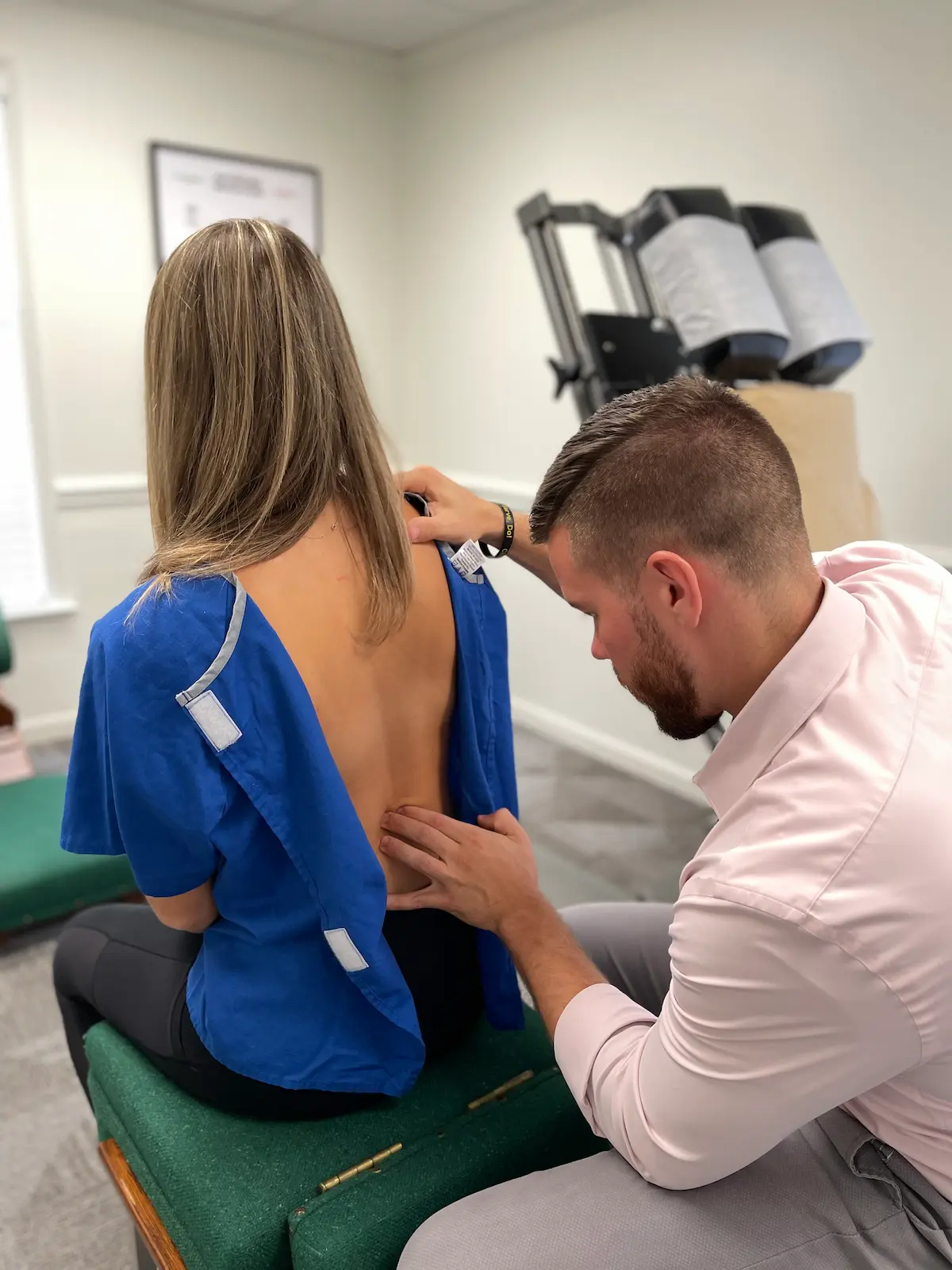
Whiplash injuries from car accidents are frequently more serious than they appear in the days immediately following a collision – and waiting to get evaluated is one of the most common mistakes people make. At Axiom Chiropractic in Southpark, we regularly see patients who dismissed their post-accident symptoms as minor, only to develop chronic neck pain, headaches, and nerve irritation weeks or months later that traces directly back to an uncorrected whiplash injury. The sooner the cervical spine is assessed and treated after a collision, the better the outcome tends to be.
What Actually Happens to the Cervical Spine in a Whiplash
Whiplash is the informal name for a cervical acceleration-deceleration injury – the rapid, forceful back-and-forth motion the neck undergoes during a rear-impact collision. The physics are straightforward: the vehicle stops suddenly, but the occupant’s head continues moving in the original direction of travel before snapping back. The entire motion happens in a fraction of a second – far too fast for the neck muscles to brace protectively.
What that motion does to the cervical spine is less simple. The rapid extension-flexion cycle can stretch or tear the ligaments and muscles supporting the cervical vertebrae, compress the facet joints at the back of the neck, create disc injury ranging from minor irritation to herniation, and most significantly – misalign individual cervical vertebrae in ways that compress or irritate the nerve roots exiting at each level.
The velocity doesn’t have to be high for this damage to occur. Research has shown significant cervical tissue injury in collisions at speeds as low as 5 to 10 miles per hour. The direction of impact, the position of the head at the time of collision, whether the headrest was positioned correctly, and the difference in vehicle weight all influence the degree of injury independent of speed.
Why Symptoms Are Often Delayed
One of the most misunderstood aspects of whiplash injuries is the delayed symptom onset. Many patients feel relatively fine immediately after a collision and assume they escaped injury. Then, 24 to 72 hours later – or sometimes longer – the neck pain, stiffness, headaches, and shoulder pain arrive.
This happens for two reasons. First, the acute stress response following an accident elevates adrenaline and cortisol, which have natural analgesic effects. The body’s stress hormones temporarily mask pain signals that would otherwise be immediate. As those hormone levels normalize over the following days, the pain surfaces.
Second, soft tissue inflammation – the body’s healing response to the stretched and torn ligaments and muscles – takes time to develop and reach its peak. The inflammatory swelling around the injured cervical structures is at its worst 24 to 72 hours after the injury, which is precisely when most patients begin feeling the severity of what happened.
The practical implication is clear: feeling okay immediately after an accident is not reliable evidence that no injury occurred. A prompt evaluation of the cervical spine – before inflammation peaks and before compensatory muscle guarding develops – gives us the most accurate picture of what happened and the best conditions for early intervention.
The Consequences of Untreated Whiplash
This is the part that justifies urgency. Whiplash injuries that go unevaluated and uncorrected have a well-documented tendency to become chronic problems.
The cervical vertebrae that were misaligned during the collision don’t spontaneously return to their correct position just because the acute pain resolves. The misalignment remains, the nerve irritation it creates continues, and the muscles around the injured segments tighten into protective spasm that gradually becomes habitual. Over weeks and months, this pattern establishes itself as the new normal – and what started as an acute injury becomes a chronic neck pain condition.
Headaches are one of the most common long-term consequences of untreated whiplash. The upper cervical spine supplies the nerve pathways that feed into the same brainstem structures that process head pain. Cervical misalignments at C1, C2, and C3 that were created in a collision but never corrected are a leading cause of persistent post-traumatic headaches – headaches that many patients have simply accepted as a permanent feature of their life after an accident.
Arm pain, numbness, and tingling are another common downstream consequence. As cervical misalignment compresses the nerve roots exiting the lower cervical spine, patients develop radicular symptoms that can appear months after the original accident with no obvious connection to the collision in their minds.
How Gonstead Chiropractic Addresses Whiplash
The Gonstead method is particularly well-suited for whiplash assessment and treatment because of its emphasis on identifying the exact vertebral levels involved and correcting them with precision – without the broad cervical rotation that would be contraindicated in an acutely injured neck.
When a post-accident patient comes in to Axiom Chiropractic in Southpark, the initial assessment is comprehensive. Full-spine weight-bearing X-rays are standard – and for accident patients, they’re especially important. The X-rays reveal misalignments created by the collision, changes in the normal cervical curve (loss of lordosis is extremely common post-whiplash), disc space changes, and any pre-existing conditions that the accident may have aggravated.
Nervoscope instrumentation scans the cervical spine for bilateral temperature asymmetry – the objective signal of nerve irritation and inflammation at specific levels. This tells us exactly where the nervous system is under stress, not just where the patient reports pain.
Adjustments in the acute phase of a whiplash injury are gentle, specific, and carefully staged. We’re not trying to aggressively correct a spine that is inflamed and in spasm. Early care focuses on reducing nerve irritation, restoring some motion to fixated segments, and supporting the tissue repair process. As acute inflammation resolves over days to weeks, more complete structural correction becomes appropriate.
Our neck pain condition page has more detail on how cervical misalignment produces the patterns whiplash patients experience, and our Gonstead chiropractic service page explains the full assessment process.
Red Light Therapy as a Complement to Post-Accident Care
For whiplash patients dealing with significant soft tissue inflammation and muscle injury, red light therapy is a meaningful addition to chiropractic care in the recovery process. Photobiomodulation at 660nm and 850nm wavelengths reduces inflammatory cytokines in injured soft tissue, accelerates collagen remodeling in damaged ligaments and muscles, and supports nerve recovery in compressed or irritated cervical nerve roots.
Combining specific cervical adjustments with red light therapy post-whiplash addresses both the structural correction and the cellular healing of the injured tissue simultaneously – which typically produces faster recovery and more complete resolution than chiropractic alone.
Documentation and Insurance
A practical note for Southpark patients who’ve been in an accident: the examination and findings from a chiropractic evaluation are clinical records that document the nature and extent of your injuries. This documentation matters if you’re pursuing an insurance claim or personal injury case.
A thorough initial evaluation that identifies specific cervical misalignments, nerve involvement, and functional limitations – supported by objective findings from X-rays and instrumentation – creates a clinical record of the injury that a patient who was told “you’re fine” by an emergency room doctor and sent home without imaging often doesn’t have.
We’re not a documentation service – our priority is your recovery. But for patients navigating accident claims, having a detailed chiropractic record of your cervical injuries is often valuable. We’re happy to discuss how our documentation process works if that’s a concern for you.
Frequently Asked Questions
How soon after an accident should I come in?
As soon as possible – ideally within the first 24 to 48 hours, once any emergency medical concerns have been ruled out. The sooner we assess the cervical spine before compensatory patterns develop, the more accurate our findings and the more responsive the tissue is to early correction. That said, it’s never too late to seek evaluation. We see patients months and years after accidents whose chronic symptoms trace back to that original uncorrected injury.
Do I need a referral from my doctor or attorney before coming in?
No referral is required to schedule at Axiom. You can book directly. If you’re working with an attorney or have an active insurance claim, let us know – we can discuss documentation and billing processes that work with your situation.
My accident was minor – do I still need to be checked?
Yes. Minor collision speed does not reliably predict minor cervical injury. The physics of whiplash mean that low-speed rear impacts can produce significant cervical tissue stress, particularly when the head is turned at the moment of impact or when the seats don’t absorb the impact effectively. A brief evaluation to confirm that the cervical spine is undamaged costs very little relative to the cost of managing chronic neck pain and headaches for years.
If you’ve been in a car accident in or around Southpark – whether recently or some time ago – and haven’t had your cervical spine properly evaluated, it’s worth doing. Call (704) 469-4772 or schedule a consultation at Axiom Chiropractic today.
Axiom Chiropractic & Wellness Center serves Charlotte, NC and surrounding communities with expert Gonstead chiropractic care, advanced red light therapy, functional medicine, and specialized animal chiropractic. Led by Dr. Tyler Hartley and Dr. Megan Hullihen, we help families overcome back pain, neck pain, headaches, sciatica, and digestive issues through precise spinal corrections. Call (704) 469-4772 or schedule online to start your wellness journey today.