
Sciatica isn’t a back problem – it’s a nerve problem that happens to originate in the back. That distinction matters more than most people realize, because it explains why so many common treatments fail to deliver lasting relief. At Axiom Chiropractic in Charlotte, we see sciatica patients regularly who have tried everything from physical therapy to injections without getting to the actual source of the issue.
What Sciatica Actually Is
The sciatic nerve is the longest nerve in the body. It forms from several nerve roots that exit the lumbar spine and sacrum, then travels through the pelvis, down through the buttock, and all the way into the leg and foot. When something compresses or irritates those nerve roots – or the nerve itself at any point along that path – you get the classic sciatica experience: pain, burning, tingling, or numbness that radiates from the low back into the hip, thigh, calf, or foot.
What makes sciatica so disruptive is that it doesn’t stay in one place. It moves. It changes. It might be a sharp shooting pain one day and a dull constant ache the next. Sitting makes it worse, then standing makes it worse, then you can’t find a position that feels neutral. That unpredictability is one of the most frustrating parts of living with it.
Why Most Treatments Don’t Fix It
The standard playbook for sciatica usually goes something like this: anti-inflammatories to calm the nerve, muscle relaxers for the spasm, physical therapy to strengthen the surrounding muscles, and maybe a steroid injection if things get bad enough. In some cases surgery gets added to the list.
None of these are inherently wrong. But they share a common problem – they address what the nerve is experiencing without correcting why the nerve is being irritated in the first place. The inflammation calms down, the pain fades, and then a few weeks or months later the same thing happens again. Sound familiar?
The reason sciatica keeps coming back for so many people is that the structural issue driving the nerve compression – usually a misalignment in the lumbar spine or pelvis – was never corrected. The body compensates, adapts, and holds things together for a while. Then something tips it back over the edge and the cycle starts again.
The Structural Root of Most Sciatica Cases
In the majority of sciatica cases we see in Charlotte, the nerve irritation traces back to one of two things – or a combination of both. The first is lumbar misalignment, where vertebrae in the lower back have lost their normal position or motion and are creating pressure on the nerve roots that form the sciatic nerve. The second is pelvic dysfunction, where the sacroiliac joints or sacrum itself is misaligned and affecting how load and tension distribute through the region where the sciatic nerve travels.
Disc involvement is also common. When lumbar discs lose normal hydration and height from long-standing misalignment, they can bulge or herniate in ways that directly compress the exiting nerve roots. This is often what gets picked up on MRI and labeled as the cause – but the disc problem itself usually developed because the spinal mechanics around it were off for an extended period.
How Gonstead Chiropractic Approaches Sciatica
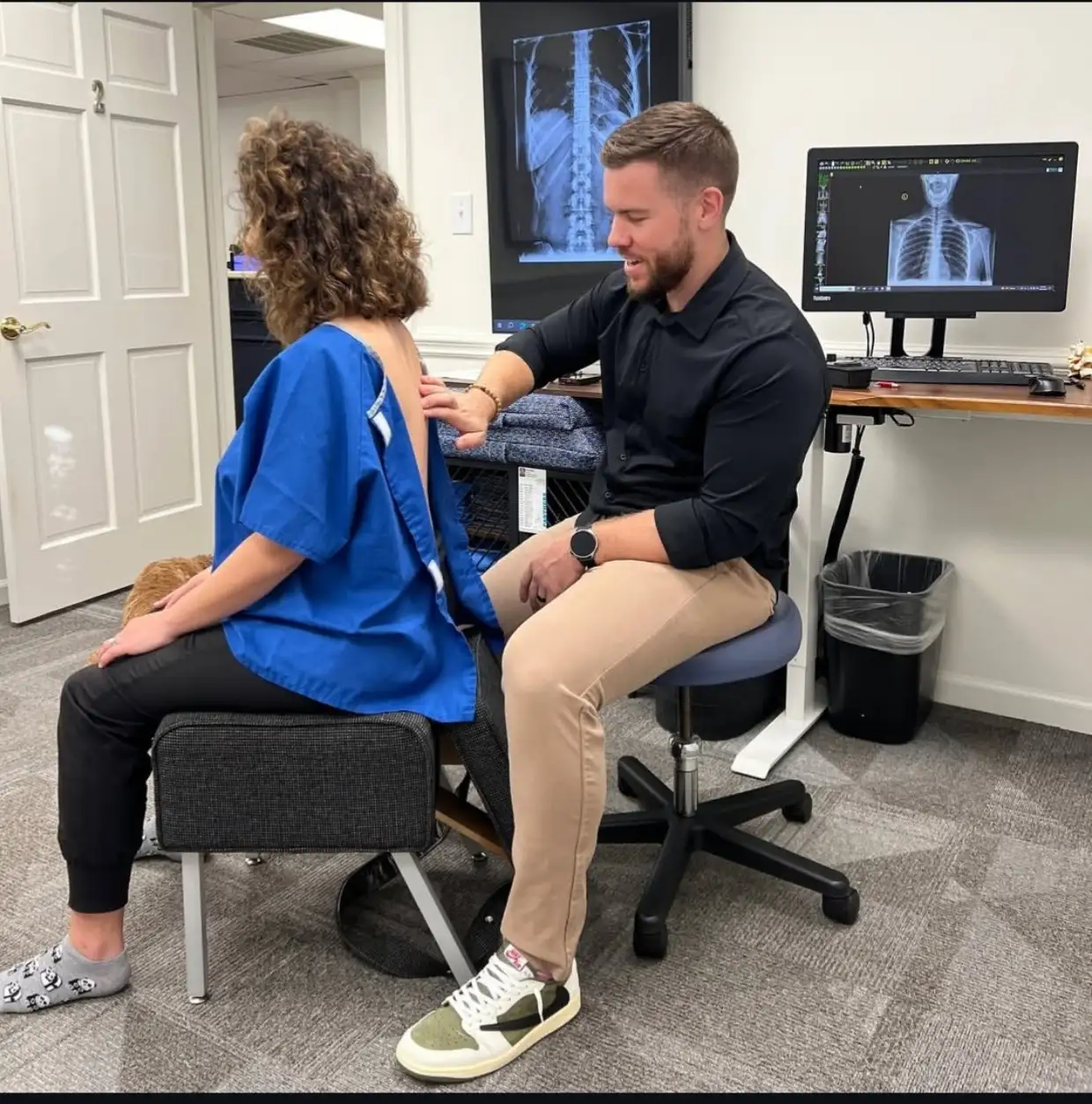
The Gonstead method is particularly well suited to sciatica because of how thoroughly it analyzes the lumbar spine and pelvis before any adjustment is made. Full-spine, weight-bearing X-rays show the actual structural relationships between the lumbar vertebrae, the sacrum, and the pelvis. Instrumentation identifies where nerve irritation is concentrated along the spine. Palpation confirms which specific segments have lost normal motion and position.
From that picture, adjustments are delivered to the exact levels that need correction – with a specific contact point, line of drive, and force. Not a general lumbar manipulation. Not the same adjustment applied to every sciatica patient. A correction based on what your spine actually shows.
As the structural problems are addressed and the nerve irritation decreases, patients typically notice the radiating symptoms pulling back – the pain retreating from the foot toward the calf, from the calf toward the thigh, and eventually resolving. That progression is a good sign. It means the nerve is decompressing and the correction is working.
What Sciatica Patients in Charlotte Tell Us
The patients who come to Axiom with sciatica often arrive skeptical. They’ve had the MRI, they’ve done the PT, and they’ve been told their options are limited. What changes their mind isn’t a sales pitch – it’s the exam. When we can show someone on their own X-ray where the structural problem is, explain how it’s creating pressure on the nerve, and lay out a specific plan to address it, the response is usually the same: why didn’t anyone look at it this way before?
We also use INSiGHT scanning and thermography to create objective baselines so that progress is measurable from the start. You won’t just be going by how you feel – you’ll be able to see what’s actually changing in your nervous system as care progresses.
When to Stop Managing and Start Correcting
If your sciatica has been flaring up and calming down for months or years, that pattern is telling you something. The nerve isn’t getting better on its own – it’s just getting quiet between episodes. Each flare-up tends to pull from the same structural problem that was never fully resolved.
Patients in the Myers Park and Cotswold areas don’t have to keep living around sciatica symptoms. A thorough Gonstead evaluation gives you a clear picture of what’s driving the nerve irritation and what it will take to correct it.
If you’re ready to stop managing and start fixing, schedule your first visit at Axiom or give us a call at (704) 469-4772. No referral needed.
Frequently Asked Questions
Can sciatica go away on its own?
Sometimes symptoms calm down without treatment, but if the underlying structural problem isn’t corrected, the nerve irritation tends to return. Repeated flare-ups often mean the root cause is still present and the body is just compensating around it temporarily.
Is chiropractic safe for sciatica caused by a herniated disc?
In most cases, yes. The Gonstead exam process identifies the nature and extent of disc involvement before care begins, and adjustments are tailored accordingly. Cases requiring imaging review or collaboration with another provider are identified during the assessment.
How many visits does it take to get relief from sciatica?
It depends on how long the problem has been present and how much structural change has occurred. Some patients notice the radiating symptoms beginning to pull back within a few visits. More chronic cases typically require a longer care plan with regular re-examinations to track objective progress.
Axiom Chiropractic & Wellness Center serves Charlotte, NC and surrounding communities with expert Gonstead chiropractic care, advanced red light therapy, functional medicine, and specialized animal chiropractic. Led by Dr. Tyler Hartley and Dr. Megan Hullihen, we help families overcome back pain, neck pain, headaches, sciatica, and digestive issues through precise spinal corrections. Call (704) 469-4772 or schedule online to start your wellness journey today.