

Yes, chiropractic care can help with digestive problems – and the reason has everything to do with your nervous system, not your stomach. The nerves that control digestion originate in your thoracic and lumbar spine, and when vertebral misalignments interfere with those nerve signals, your digestive system can pay the price. At Axiom Chiropractic in Charlotte, we regularly see patients whose bloating, irregularity, and gut discomfort improve significantly once spinal interference is corrected.
The Gut-Spine Connection Most People Don’t Know About
When most people think about digestion, they think about food, enzymes, and gut bacteria. Those things matter. But the entire digestive process – from the moment food enters your stomach to the moment waste exits your body – is coordinated by your nervous system.
Your digestive organs don’t run on autopilot. They receive constant nerve signals telling them when to contract, when to secrete enzymes, when to relax, and how quickly to move things along. Disrupt those signals, and the whole system gets dysregulated.
Where do those signals come from? Your spine.
The Thoracic Spine and Your Stomach
The nerves that supply the stomach, liver, gallbladder, and small intestine exit from the mid-thoracic spine, roughly between T5 and T9. Misalignments in this region can interfere with nerve communication to these organs – affecting stomach acid secretion, bile flow, and the coordinated muscle contractions that move food through your digestive tract.
The Lumbar Spine and Your Large Intestine
The lower lumbar spine and sacrum supply the large intestine and colon. This is the section responsible for water absorption and the final movement of waste. When the lumbar spine or pelvis is misaligned, the nerve supply to this area can be compromised – which often shows up as constipation, irregularity, or bloating in the lower abdomen.
The Vagus Nerve Connection
The vagus nerve is the major parasympathetic nerve governing digestion – it’s responsible for what’s called “rest and digest” function. When your nervous system is stuck in sympathetic (fight-or-flight) overdrive because of spinal stress, vagus nerve activity is suppressed. Digestion slows. Gut motility decreases. Bloating and discomfort follow.
Correcting spinal misalignments helps shift the nervous system back toward parasympathetic balance – which is exactly what the digestive system needs to function properly.
What Digestive Symptoms May Signal a Nerve Problem
Not every case of bloating or constipation is a chiropractic issue. But certain patterns suggest the nervous system may be involved:
Chronic bloating without a clear dietary cause. If you’ve already tried eliminating trigger foods and still deal with persistent bloating, it’s worth asking whether nerve interference to the digestive organs is playing a role.
Irregularity that doesn’t respond to fiber and hydration. The classic first advice for constipation – drink more water, eat more fiber – is sound. But if it isn’t working, the problem may be neuromuscular rather than dietary. The colon needs proper nerve signals to coordinate its muscle contractions.
Digestive symptoms that accompany back pain or posture problems. When gut issues and spinal pain show up together, that’s often a meaningful signal. Both may be products of the same underlying misalignment pattern.
Worsening during stress. Stress loads the sympathetic nervous system and suppresses digestive function. Patients who notice their gut symptoms spike during stressful periods often have an underlying spinal issue that’s already keeping the nervous system close to sympathetic overdrive – stress just pushes it over the edge.
How Gonstead Chiropractic Addresses Digestive Issues in Charlotte
At Axiom, we don’t adjust the spine and hope the digestion improves. We use the full Gonstead five-criteria analysis to identify specifically which vertebral levels are misaligned and what nerve supply they’re interfering with.
When a patient comes in with digestive complaints alongside spinal findings, we’re looking at:
Thoracic Spine Assessment
Our instrumentation (the Nervoscope) scans for bilateral temperature differences along the thoracic spine. Heat asymmetry in the mid-thoracic region points to inflammation and nerve irritation at levels that correspond to digestive organ innervation. This isn’t guesswork – it’s an objective reading that guides where we adjust.
Full-Spine X-Ray Analysis
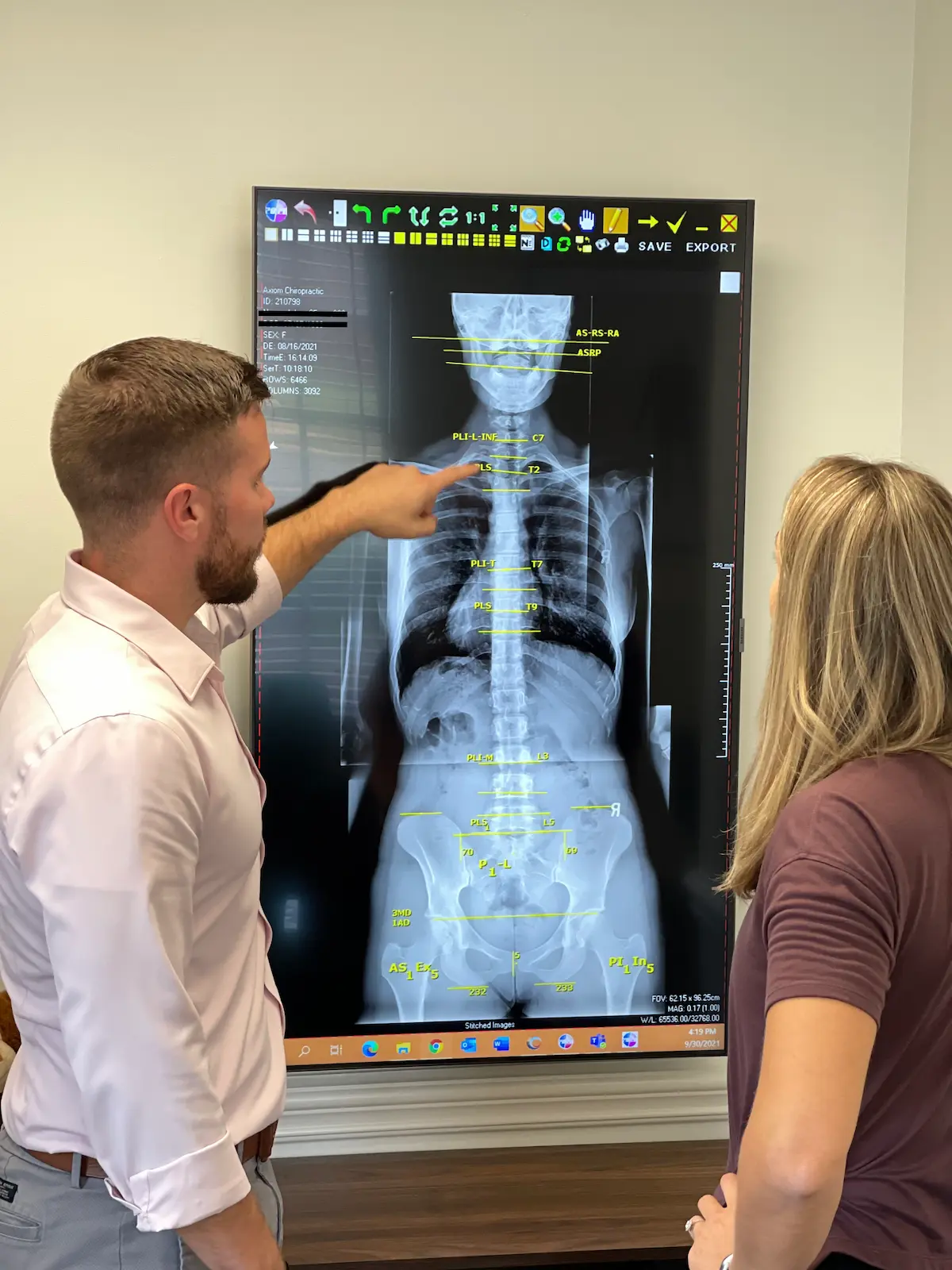
Weight-bearing full-spine X-rays show us the actual structural position of the thoracic and lumbar spine – including any rotational misalignment of individual vertebrae. We’re looking at disc space, vertebral angle, and overall spinal curvature as it relates to where nerve roots exit the spine.
Specific Gonstead Adjustments
Once we’ve identified the misaligned segments, the adjustment is delivered with a precise line of drive, a specific contact point on the affected vertebra, and a controlled force – no rotation, no twisting. The goal is to restore proper vertebral position and motion so the nerve supply to the digestive organs can function without interference.
You can read more about how the full process works on our Gonstead chiropractic service page.

What Patients Actually Experience
Digestive improvement is one of the secondary benefits patients regularly report with Gonstead care, even when they came in for something else entirely. It shows up in reviews, in conversations at follow-up visits, and in re-examination findings as spinal alignment improves.
The pattern we see most often: a patient starts care for mid-back or low back pain, and within a few weeks mentions their digestion has also improved – less bloating, more regular bowel movements, less abdominal discomfort. They didn’t expect it. But it makes sense once you understand the nerve supply that was being restored.
For patients who come in specifically for digestive issues, we treat the spine as we would for any other case – through objective analysis and specific correction. We don’t promise gut healing. We correct the spinal interference that may be disrupting the nerve communication your digestive system depends on, and we let the body respond.
The Functional Medicine Side of Gut Health
It’s worth being honest: spinal nerve interference is one possible contributor to digestive dysfunction, not the only one. Gut bacteria imbalances, food sensitivities, hormone disruption, and nutrient deficiencies can all play a role.
This is one reason Axiom offers more than chiropractic care. Our functional medicine and blood work service can identify underlying biochemical contributors to gut issues – things like thyroid dysfunction (which significantly affects gut motility), cortisol imbalances that suppress digestive function, or nutrient deficiencies that impair the gut lining.
In many cases, addressing both the structural component (spinal correction) and the biochemical component (functional blood work) produces results that neither approach achieves alone. For Charlotte patients dealing with chronic, stubborn gut issues, this combination is often the missing piece.
Chiropractic for Kids With Digestive Problems
This is worth a specific mention because pediatric digestive issues – colic in infants, chronic constipation in toddlers, irregular bowel function in school-age children – are surprisingly common, and chiropractic is rarely the first place parents think to look.
The same principle applies to children: the nerves controlling gut function originate in the spine, and birth trauma, falls, and developmental stress can all create spinal misalignments that affect those nerve pathways. Gentle, low-force Gonstead adjustments appropriate for children’s developing spines can restore that nerve supply without any discomfort.
Several Charlotte families have come to Axiom initially for pediatric digestive concerns and found meaningful improvement with consistent care. If your child is dealing with chronic gut issues that haven’t resolved with dietary changes alone, it may be worth having their spine assessed.
Frequently Asked Questions
How many visits before digestive symptoms improve?
There’s no universal timeline. Some patients notice changes within the first few weeks of care. Others with more longstanding misalignments take longer to respond as the nervous system recalibrates. We track objective progress with re-examinations so you’re never guessing.
Do I need a referral from my GI doctor?
No referral is required. You can schedule directly with us. If your digestive symptoms are severe or have never been evaluated medically, we’d also encourage you to rule out structural GI issues with a gastroenterologist – chiropractic care and GI medicine are not mutually exclusive.
Is this approach backed by research?
The nerve anatomy connecting the spine to digestive organs is well-established in the medical literature. Clinical evidence for chiropractic improving gut function is growing, with case studies and small trials showing positive outcomes – particularly for constipation and colic. We’re transparent that more large-scale research is needed, but the mechanism is sound and our clinical experience in Charlotte supports it.
If you’re dealing with chronic digestive issues that haven’t responded to dietary changes or conventional treatment, your spine may deserve a closer look. Call us at (704) 469-4772 or book a consultation at Axiom Chiropractic in Charlotte and let’s find out what your nervous system has to say about it.