Poor posture is not just a cosmetic problem or a sign of laziness – it’s a structural condition that alters nerve function, changes how load is distributed through every joint in the body, and over time contributes to pain, fatigue, and dysfunction far beyond the back and neck. At Axiom Chiropractic in Southpark, posture assessment is built into every patient evaluation because the way someone stands and moves tells us as much about their spine as any instrument or X-ray. What we see in their posture predicts what we’ll find when we look deeper.
What “Good Posture” Actually Means Structurally
Good posture isn’t about standing up straight through sheer willpower. It’s the result of a spine that maintains its natural curves, joints that sit in their optimal positions, and muscles that are neither chronically overloaded nor chronically underactivated.
The spine has three natural curves: a forward curve in the cervical region (lordosis), a backward curve in the thoracic region (kyphosis), and a forward curve in the lumbar region (lordosis again). These curves work together to distribute the compressive load of gravity efficiently along the entire spine – essentially functioning as a spring that absorbs and transfers force without concentrating it at any single level.
When these curves are well-maintained, the head sits balanced over the shoulders, the shoulders sit over the hips, and the hips are balanced over the feet. The muscles required to hold this position are working at their designed length and tension – which is why people with genuinely good structural posture aren’t exhausted by standing. The structure is holding them up, not their muscles.
Poor posture describes the loss of this arrangement. Usually, it shows up as forward head position, reduced cervical lordosis, increased thoracic kyphosis (rounding of the upper back), and often a compensatory flattening of the lumbar curve. The whole stack shifts forward, and the muscles of the back and neck have to work constantly just to prevent the person from falling over.
The Forward Head Problem
Forward head posture deserves specific attention because it’s the most common postural deviation we assess in Southpark patients – and its consequences are more significant than most people realize.
The head weighs roughly 10 to 12 pounds in a neutral position. For every inch the head sits forward of its balanced position over the shoulders, the effective weight the cervical spine must support increases dramatically. At two inches forward – which is typical for someone who uses a phone or computer regularly – the neck is effectively supporting the equivalent of 30 to 40 pounds rather than 10 to 12.
That sustained load does several things. It compresses the cervical discs unevenly, accelerating degeneration at the lower cervical levels. It loads the facet joints at the back of the neck into chronic compression, producing stiffness and eventual arthritis. It stretches the ligaments at the front of the cervical spine and shortens the muscles at the back, creating an imbalance that progressively worsens without correction. And it irritates the nerve roots exiting the lower cervical spine – contributing to the shoulder tension, arm numbness, and headaches that so many desk workers in Southpark describe as just part of their daily existence.
How Posture Affects the Whole Body – Not Just the Spine
The full-body consequences of poor posture are where the picture gets broader than most people expect.
Breathing and Lung Capacity
The thoracic spine and ribcage work together to allow the chest to expand with each breath. When thoracic kyphosis increases and the upper back rounds forward, the ribcage is compressed into a position that limits its ability to expand fully. The diaphragm – the primary breathing muscle – is mechanically disadvantaged in a rounded posture. The result is shallower breathing, reduced oxygen exchange per breath, and a subtle but chronic oxygen deficit that contributes to fatigue and reduced cognitive performance.
Patients who restore thoracic extension through postural correction and chiropractic care frequently comment on how much deeper and easier their breathing becomes – a benefit most hadn’t expected from spinal work.
Digestive Function
A slumped posture compresses the abdominal cavity. The stomach, intestines, and surrounding organs have less space to function in. Peristalsis – the wave-like muscle contractions that move food through the digestive tract – is affected by the neurological input from the thoracic and lumbar spine, which is itself compromised by poor spinal alignment. Chronic forward slumping is a frequently overlooked contributor to bloating, reflux, and irregular digestion.
Mood, Energy, and Cognitive Performance
The research on this is more robust than most people expect. Studies have consistently found that posture influences mood and stress response through both mechanical and hormonal mechanisms. Upright posture is associated with higher self-reported energy, more positive emotional states, and lower cortisol in response to stressors. Slumped posture produces the opposite – and it’s not simply that sad people slump. The posture itself appears to influence the hormonal and neurological state, not just reflect it.
From a nervous system standpoint, this makes sense. Forward head posture and thoracic rounding load the sympathetic nervous system – the stress response branch – in ways that keep the body’s baseline stress tone elevated. Correcting posture reduces that mechanical sympathetic load, which allows the nervous system to spend more time in the parasympathetic state associated with calm, focus, and recovery.
Joint Load and Extremity Pain
When the spine’s alignment shifts forward, the entire body compensates downstream. The pelvis tilts to accommodate the shifted center of gravity, which changes the angle at which the hip joints load. The knees compensate for the altered hip mechanics. The ankles and feet adjust to the changed load pattern above them.
Over time, this cascade of compensation produces wear patterns in the hip, knee, and ankle joints that wouldn’t exist in a well-aligned spine. Southpark patients who present with hip or knee pain that has no obvious local cause often have a postural and spinal alignment story that explains exactly why those joints are being stressed.
What Correcting Posture Actually Requires
Telling someone to “stand up straight” accomplishes nothing lasting – and this is where the conventional advice on posture falls completely short.
Posture cannot be corrected by muscular effort alone when the underlying spinal segments are misaligned. A cervical spine that has lost its lordosis because of years of vertebral misalignment won’t restore that curve through stretching and strengthening exercises, because the structural position of the individual vertebrae isn’t something muscles can change. Muscles respond to the position of the joints they cross – they don’t reposition joints that are structurally displaced.
This is why Gonstead chiropractic is the appropriate starting point for genuine postural correction. The Gonstead method addresses the vertebral misalignments that are holding the spine in its dysfunctional position. Full-spine weight-bearing X-rays show us exactly how each region of the spine is positioned and which segments need correction. Specific adjustments restore normal vertebral position and motion, which gives the muscles a corrected structural foundation to work from.
Muscle rehabilitation – strengthening the deep cervical flexors, the thoracic extensors, and the lumbar stabilizers – is a valuable complement to chiropractic correction. But it works best after the structural corrections are made, not instead of them. Building strength around a misaligned spine doesn’t fix the misalignment – it just makes the compensation pattern stronger.
Postural Assessment at Axiom
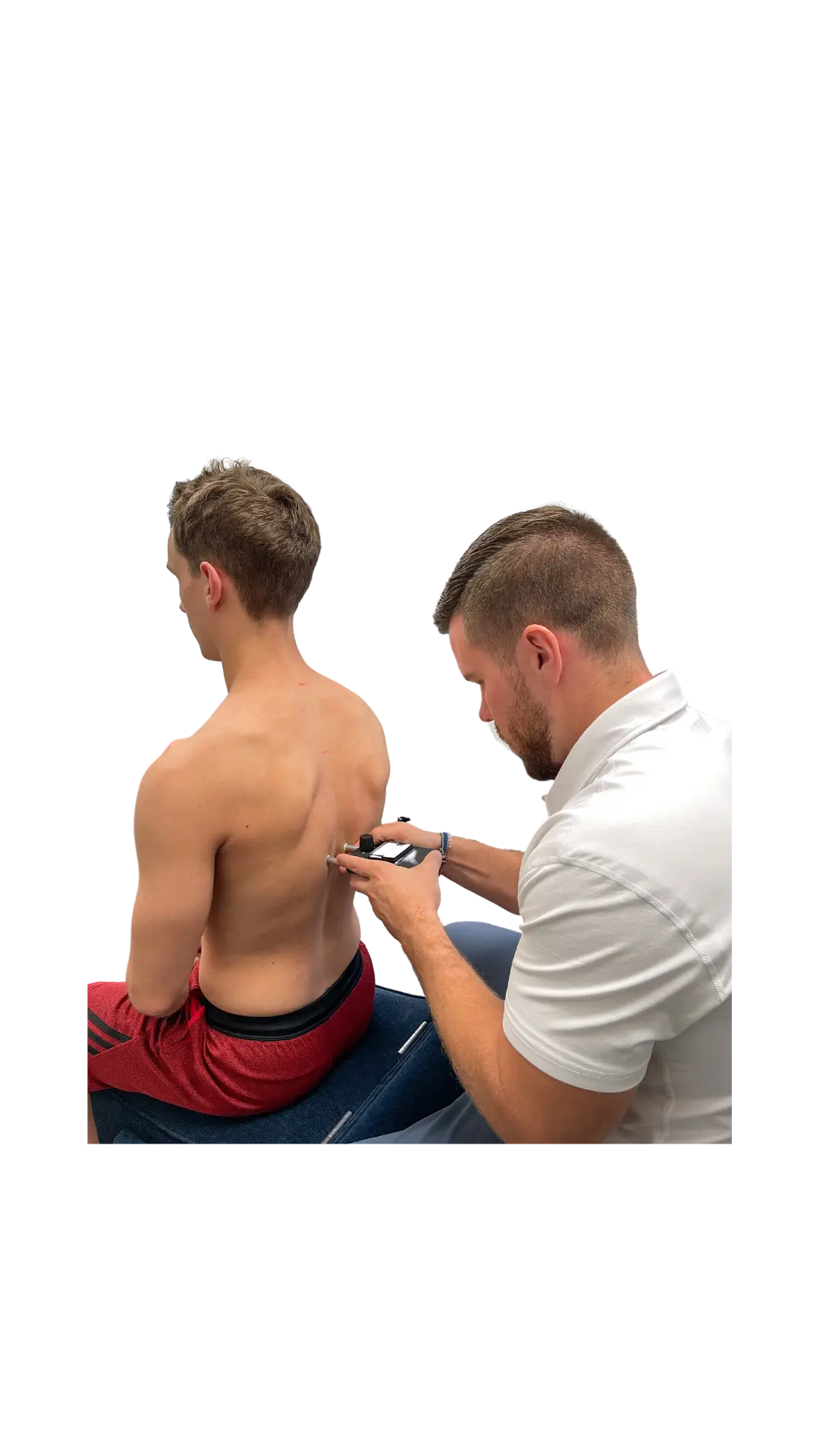
At Axiom, postural analysis is one of the five criteria in our Gonstead assessment. From the moment a patient walks in the door, Dr. Tyler and Dr. Megan are evaluating how they carry themselves – the height of the ears, shoulders, and hips, the position of the head relative to the shoulders, the way the patient moves and distributes weight when walking.
These observations are then correlated with X-ray findings, instrumentation readings, and palpation findings to build a complete picture of the structural situation. Changes in posture over the course of a care plan are a visible, external confirmation of what we’re also tracking on re-examination scans and X-rays – the two measures together give patients and practitioners an objective sense of real structural progress.
If neck pain, back pain, chronic tension, or fatigue are part of your daily life in Southpark, your posture and spinal alignment may be driving more of it than you’ve been told. Call (704) 469-4772 or schedule a posture and spinal assessment at Axiom Chiropractic and find out what’s actually holding your body in the position it’s in.
Frequently Asked Questions
Can adults with long-standing poor posture actually correct it?
Yes – though the timeline and degree of correction depends on how long the pattern has been present and how much structural change has occurred. Significant postural improvement is achievable at any adult age with consistent chiropractic care and appropriate muscle rehabilitation. Complete reversal of advanced degenerative changes isn’t realistic, but meaningful functional improvement almost always is.
Are there exercises I should be doing alongside chiropractic care?
Yes, and we’ll discuss specific recommendations based on your findings. Generally, deep cervical flexor strengthening, thoracic extension exercises, and hip flexor mobility work complement cervical and thoracic chiropractic corrections well. We provide guidance on what’s appropriate at each stage of a care plan – because the wrong exercises at the wrong time can actually work against structural correction.
How long before I notice postural changes?
Most patients notice subjective changes in how they feel – less neck tension, easier breathing, reduced fatigue from sitting and standing – within the first few weeks of care. Visible postural changes that show up on comparative X-rays or in photos typically take longer, often several months of consistent care, because structural spinal correction is a gradual process.
Axiom Chiropractic & Wellness Center serves Charlotte, NC and surrounding communities with expert Gonstead chiropractic care, advanced red light therapy, functional medicine, and specialized animal chiropractic. Led by Dr. Tyler Hartley and Dr. Megan Hullihen, we help families overcome back pain, neck pain, headaches, sciatica, and digestive issues through precise spinal corrections. Call (704) 469-4772 or schedule online to start your wellness journey today.