A herniated disc that isn’t improving after weeks of rest, medication, or even physical therapy is one of the most frustrating experiences a patient can have. In most cases, the disc itself isn’t the root problem – it’s the spinal instability and misalignment that caused the disc to herniate in the first place. At Axiom Chiropractic in Southpark, we use the Gonstead method to identify exactly which spinal segments are involved and correct them with precision, giving the disc the mechanical environment it needs to heal.
Why Herniated Discs Keep Coming Back
Most people think of a herniated disc as an injury to a single structure – the disc itself. But discs don’t just herniate randomly. They herniate because the spinal segment above and below them has lost normal motion, stability, or alignment.
When a vertebra shifts out of position, it changes how pressure is distributed across the disc. Over time, that uneven pressure causes the disc’s outer layer (the annulus fibrosus) to weaken and the inner gel (the nucleus pulposus) to push outward. That’s the herniation.
Here’s the problem with most treatment approaches: they address the pain the disc is causing, but not the mechanical reason the disc herniated. Rest reduces inflammation temporarily. Anti-inflammatories quiet the symptoms. But if the underlying spinal misalignment isn’t corrected, the disc stays under abnormal pressure – and the pain keeps coming back.
What the Gonstead Method Finds That Others Miss
At Axiom, we don’t guess where the problem is. Every new patient goes through a five-criteria Gonstead analysis before any adjustment is made. This process is specifically designed to find the exact vertebral levels causing disc stress.
Full-Spine X-Ray Analysis
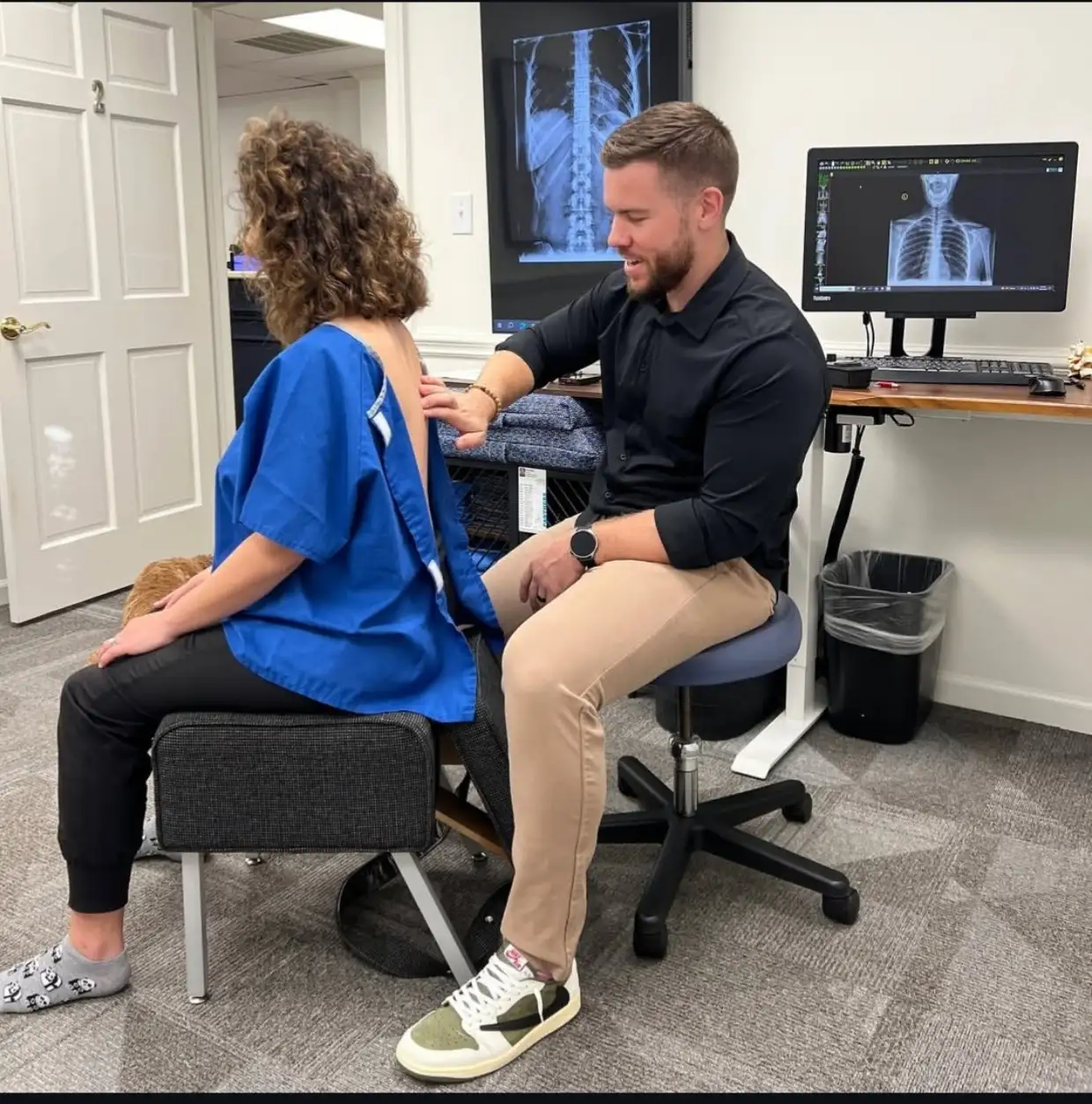
We take weight-bearing, full-spine X-rays – not just sectional films. Weight-bearing images show us how gravity is actually loading your spine when you’re standing and moving. This reveals disc space narrowing, vertebral tilt, and structural compensation patterns that can’t be seen on an MRI taken while lying flat.
Full-spine films also let us see the entire spinal picture. A herniated disc in your lower back may actually be connected to a compensatory pattern starting much higher up. Treating only the lumbar spine without seeing the thoracic and cervical spine means missing half the picture.
Nervoscope Instrumentation
We use a dual-probe Nervoscope to scan the spine and detect bilateral temperature differences. Nerve irritation and inflammation show up as heat asymmetry – a reliable, objective signal that tells us exactly where the nervous system is under stress. This confirms our X-ray findings and helps us track whether the disc pressure is responding to care over time.
Static and Motion Palpation
Hands-on assessment of each spinal segment helps us identify restricted motion, abnormal contour, and changes in muscle tone around the affected levels. A disc herniation at L4-L5, for example, will often have specific palpation findings at that level that match our imaging and instrument findings.
The Difference Between a Gonstead Adjustment and a General Manipulation
This is where Gonstead chiropractic separates itself from general chiropractic care – and it matters a great deal when a disc is involved.
A general manipulation often involves rotation of the spine. Twisting a spine with an active disc herniation can increase intradiscal pressure and, in some cases, worsen the injury. This is one reason some patients feel worse after seeing a general chiropractor for disc pain.
A Gonstead adjustment uses a specific line of drive, a specific contact point, and a specific force calculated for that exact vertebral level. There’s no rotation. The adjustment is designed to restore normal motion and position to the misaligned segment without placing additional stress on the disc.
For our Southpark patients dealing with disc pain, this distinction is the difference between care that helps and care that may aggravate. We’re not adjusting your whole spine – we’re adjusting the segments that need it, in the exact direction they need it.
What Disc Healing Actually Requires
Herniated discs can and do heal. The body is remarkably capable of reabsorbing disc material and remodeling the annulus over time – but only when certain conditions are met.
Mechanical Correction First
The disc needs to be taken off abnormal pressure. As long as the vertebrae surrounding the disc are misaligned, the disc cannot heal correctly regardless of how much rest you get or how many anti-inflammatories you take. Gonstead adjustments restore normal vertebral position so the disc can decompress and receive proper fluid exchange.
Nerve Pressure Must Be Reduced
A herniated disc that’s pressing on a nerve root causes the radiating pain, numbness, and tingling many patients describe – symptoms that often travel into the leg (in lumbar herniations) or arm (in cervical herniations). The nerve itself also needs time to recover once that pressure is relieved. Consistent chiropractic care reduces and eventually eliminates that nerve irritation as the disc improves.
If you’re also dealing with leg pain from a disc herniation, our sciatica condition page explains how that nerve pathway works and what to expect with care.
Consistency Over Time
This is the part that’s hardest for people to hear: disc healing takes time. Structural correction of the spine isn’t a one-visit fix. Most patients with significant herniations need a consistent care plan over several weeks or months, with regular re-examinations to confirm the disc is responding.
We use objective re-exams – repeat instrumentation scans, palpation reassessments, and in some cases updated X-rays – to track actual progress. You’ll always know where things stand.

Common Mistakes That Slow Disc Recovery
A few patterns we see regularly in Southpark patients who’ve struggled to heal:
Stopping care when pain improves. Pain reduction is an early sign of progress, but it’s not the same as structural correction. If you stop care as soon as you feel better, the underlying misalignment may still be there – and the disc remains vulnerable to re-herniation.
Relying on epidural injections alone. Steroid injections can reduce inflammation around an irritated nerve and provide real temporary relief. But they don’t correct spinal alignment or restore disc mechanics. Many patients find they need repeat injections as the effects wear off because the root mechanical problem hasn’t been addressed.
Waiting too long to seek care. The longer a spinal misalignment goes uncorrected, the more secondary compensation the spine builds around it. Adjacent joints take on extra load, muscles tighten to splint the area, and the disc continues to degenerate. Earlier intervention generally means faster and more complete recovery.
How We Approach Disc Pain at Axiom Chiropractic
When a new patient comes in with a confirmed disc herniation – whether it’s been diagnosed on MRI or is suspected based on their symptom pattern – here’s what we actually do.
We start with a comprehensive consultation and history to understand the full picture: where the pain is, how it started, what makes it better or worse, what treatments they’ve tried, and what their daily life looks like. Then we run the full Gonstead assessment – instrumentation, full-spine X-rays, palpation, posture analysis.
From there, Dr. Tyler or Dr. Megan reviews every finding with the patient in detail before recommending a care plan. You’ll see your X-rays, understand what they show, and know exactly which segments are being targeted and why.
Our Gonstead chiropractic service page has more detail on how this process works start to finish.
Is Surgery Always the Answer for Herniated Discs?
Not by a long shot. Surgery for disc herniations is sometimes necessary – particularly in cases with severe neurological compromise like progressive muscle weakness or loss of bladder/bowel control. But the majority of herniated disc cases respond well to conservative care when that care is specific and consistent.
Research consistently shows that many herniations reabsorb naturally over time. The question is whether the mechanical environment is set up for that to happen, or whether ongoing misalignment is working against the healing process.
We’re happy to be honest with patients when we think a case is beyond what conservative chiropractic care can address. But in our experience, many people who’ve been told surgery is their only option haven’t yet tried specific, corrective chiropractic care with a practice that uses the Gonstead method.
Frequently Asked Questions
Can chiropractic make a herniated disc worse?
General spinal manipulation that involves twisting and rotation can increase disc pressure and may not be appropriate for active herniations. Gonstead adjustments avoid rotation entirely and are delivered with a specific, controlled force. This is one of the key reasons we use Gonstead exclusively for disc cases rather than general manipulation techniques.
Do I need an MRI before coming in?
Not necessarily. Many patients come in with only their symptom history, and our full assessment process can identify the spinal levels involved without prior imaging. If you have an existing MRI, we’ll absolutely review it. If additional imaging is needed after our assessment, we can advise accordingly.
How long before I notice improvement?
Some patients notice relief within the first few visits. Others with more significant herniations take longer to respond. Honest answer: it depends on the severity of the disc damage, how long the problem has been present, and how consistently you stick with the care plan. We’ll give you a realistic picture after your initial exam.
If your disc pain hasn’t responded the way you hoped to rest, injections, or general chiropractic care, it may be time to look at what’s actually driving the problem. Call us at (704) 469-4772 or schedule a consultation at Axiom Chiropractic in Southpark and let’s find out what’s really going on.